How To Fix Lower Back Pain
© Jolie Bookspan, MEd, PhD, FAWM
![ALT =[“Dr. Jolie Bookspan, researcher in human physiology in extreme environments, clinician in fixing pain and injuries: More on Dr. Bookspan's web page - http://drbookspan.com/research.html"]](images/DrBookspanPhotoName.jpg)

Welcome to Fix Your Back Pain on my large free web site DrBookspan. I am a researcher and clinician in human physiology and the medicine of survival in extreme environments. From jet cockpit to combat swimmers, I study why common training and pain rehab methods don't work and what works better. I spent years in the lab researching methods to fix pain - evidence-based, primary source research - and put the results here on my web site for the benefit of the world. Get better and the world will be better.
Lower back pain can often be easy to fix. This Get-Started-Right-Now summary shows how to identify and stop a few common causes of lower back pain. Then the pain stops and your back can heal. You don't need to stop activity. With healthy movement, you can do more than before.
Then there is a wealth of knowledge still to give. See the books. A little about my work is on the Adventure Medicine page and Diving and Aerospace. My schooling is on the Bio page. Early work and "the years I thought I'd never mention again" is on Rare Photos.
SITE MAP. At the bottom of this page, and every page, are main navigation links.
Answers In A Nutshell
My work is not "alternative medicine." This is evidence-based sports medicine techniques, applied to daily life where you actually need it. I consider it simple, common sense, standard of care.
Back pain is not a disease or condition or something that once you have, you have it for life. It is usually an injury like a sprained ankle, that with a little common sense and information can heal, and you can be better than before.
You do not need to give up activities you love to do. Not all exercise is healthy, just like not all foods. This article shows you how to change common movement habits to healthy ones. You will get the built in exercise you need for health while you prevent common causes of back pain. This is different from doing sets and reps of exercises then going back to injurious daily habits.
Back muscle pain, discs that degenerate bulge or herniate, facet injury, narrowing, and most joint injury are not the cause of the problem, they are usually the RESULT of what you are doing to hurt your back. Even when inflammation or immune response are identified, they are usually results not causes. This article shows how to understand and fix causes.
You may have several causes of pain. If you fix only some of them, you will fix only some of your pain. The answer is not to continue on missing the rest saying, "it just takes time." Check for other causes you may have missed and fix them all. Then you will stop all pain, and instead of alternating feeling better from fixing one thing and hurting from other causes, wondering why you have intermittent results, you fix all and heal all and get back to your life stronger and better than before.
You do not need special chairs, beds, devices, or gimmicks to "put you" into any specific posture or position.
Not all back pain is from what shows on an x-ray or other test or scan. You are not doomed by all scan results
Study of posture rules, posture exercises, and posture devices has shown they have made as much or more pain and damage as slouching, and do not create healthy movement. They are also no fun. Instead, healthy lengths during movement needs to be learned first. Then all daily movement becomes healthy and comfortable, and builds in non-injuring movement as habit.
This article summarizes all the above. Make sure you understand the concepts (many highlighted in green). Understanding concepts helps more tghan blindly doing a bunch of exercises. The bottom of every page on my web site gives main navigation links for more.
If you have lower back pain from long standing, walking, and running, and you feel better to sit or lean over, especially if you hurt more to lie flat face up or down, start with my separate article to fix standing pain, then come back here for the rest. If you have back pain from several causes including facet, you can start here then go to the fix standing pain article.

Matt had severe disc injury. Several doctor opinions were for surgery. Shortly after working with me in Spring 2015, he was able to go back to hiking, climbing and skiing, more about this at the end of this article. A year and a half later, he wrote me, "I spent a month skiing last winter in Montana and another month hiking and exploring in Colorado and Arizona last summer. I did everything from ski knee deep powder to hiking a 14,000 ft mountain. I'm so happy I found you and your information and never got surgery."
Back Pain – Why?
Studies and news reports state that back pain is mysterious and difficult to remedy, but back pain does not have to be difficult to fix or prevent.
People do an astonishing number of things every day to do ordinary activities with injurious movement habits. They bend wrong hundreds of times every day. They do exercise with the same poor body mechanics. They stand, bend, sit, and lift wrong every day, hold muscles tightly while they move around, then do bad exercises that add to the strain. People wonder why they still get pain even though they "do their exercises." They do "back exercises," but do not know that strong muscles will not automatically give you healthy posture, make you bend and lift properly, or make up for all the things you do the rest of the day to injure yourself. Back pain treatments are done by the hundreds of thousands daily: physical therapy, surgery, exercise, massage, pain management, chiropractic, acupuncture. Pain may reduce at the time, as almost any movement makes you feel briefly better, or the treatments are done lying down in positions where most people would feel better anyway. Pain returns if you have not stopped the cause. Many wind up in back surgery, or long term or recurring pain, not understanding why their physical therapy or exercise program, or pills, or yoga "didn't work." They call it "stress." Instead, it is simple to retrain unhealthful movement and habits. Stop the cause of the injury and the pain will stop.
Instead of doing good rehab exercises then going back to damaging daily life movement, I have developed functional (useful) health and exercise movement mechanics to add to living and moving in healthy ways during all you do.
Follow-up from Pravir Patel:
"Hello Dr Jolie, Hope this email finds you in best of your health, It has been a long time since I have written to you. I have been doing really good with my back by doing just the basic things that you had suggested and advised. So am really thankful for that."
Here is How
1. Bad Discs (herniation, degeneration, bulging, slipping discs), Sciatica, and Lower Back Strain
If you have disc pain or sciatica, the following will get you starting fixing it. Then use the full FIX DISC Pain and Sciatica page.
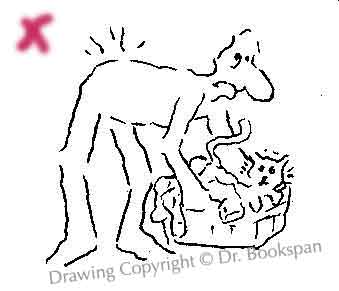
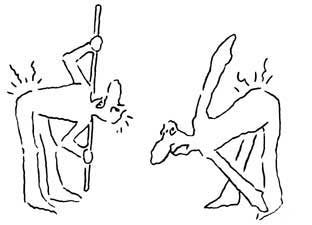
Bad bending injures discs. You know you shouldn't bend wrong, But you do – all day, every day – picking up socks, petting the dog, for laundry, trash, making the bed, looking in the refrigerator, and all the dozens of times you bend over things. Then you go to the gym and lift weights bent over, stretch by touching your toes, yoga with repeated forward bends, then lift and carry bags like that. No wonder your back eventually accrues damage and injury.
Years of bent forward sitting and standing, and bad lifting and stretching where you stand or sit and lean forward, are enough to injure your back over time as badly as a single accident.
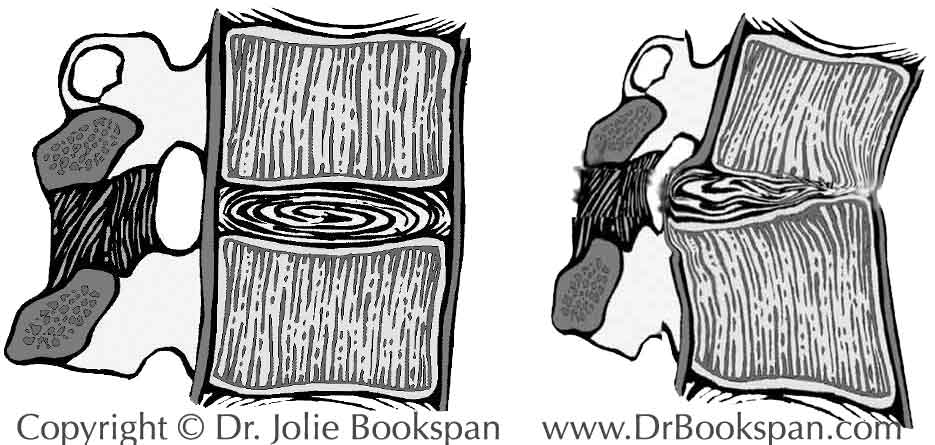
After years of pushing discs outward with unhealthy bending and forward rounding, the discs can eventually break down (degenerate) and push outward (herniate). The resulting herniation can press on nearby nerves, sending sciatic pain down your leg. If you squash and push the discs in your neck with a forward head posture - letting your head drop forward, and/or constantly holding your chin forward and up, the disc(s) in your neck may herniate and press on nerves, sending pain down your arm. Shoulder stands and yoga plows are becoming more known as common sources of herniation and bone spur.
Chronic forward bending (flexion) sheers and pushes vertebral discs outward, and overstretches the muscles and long ligament down the back, allowing more room for discs to protrude centrally instead of more to the side. Tight muscles from years of poor positioning and short resting muscle length can also press on the same nerves mimicking sciatica.
A degenerating disc is not a disease, but a simple, mechanical injury that can quickly heal, if you stop grinding it and physically pushing it out of place with unhealthy habits.
Side view of your spine. Left - normal disc between two vertebrae. Right - disc pushed out (herniated) from bad bending habits. Chronic forward bending from bad sitting and bad bending over sheers the discs and gradually pushes them outward.
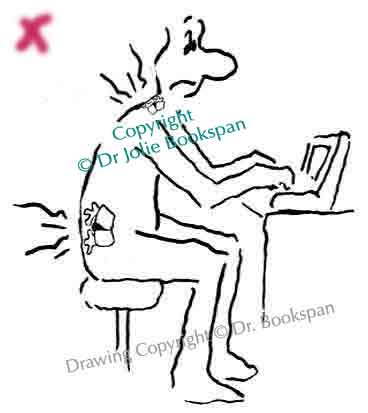
Sitting with lower back rounded (and constant bad bending)
can eventually hurt the soft tissue and push lower back discs outward (herniate or bulge)
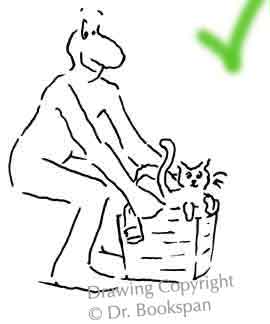
Use good bending instead. Using good bending and healthier sitting instead of band bending and sitting (not in addition to bad bending) is key to stop the major cause of disc and lower spine damage.
Instead of damaging yourself all day, many times a day, stop the damage, and the pain stops with it. Then your injuries can heal. Good bending also gives you built in strength and stretch that further helps fix pain and gives better overall health built in to your ordinary day, without exercises needed. Done right good bending will not hurt your knees and can be used to strengthen and prevent knee pain as well. Slouching over forward, rounding, bending over constantly for slouching and exercise is also not good for someone with osteoporosis. Compressing the front of the vertebrae under load may add to wedge fragility fractures.
Other good things to try also follow below in this article. More specifics about discs are in the Fixing Discs article.
Strengthening Is Not The Only Key
Strengthening does not make you bend or move in healthy ways. Many people do strengthening exercises and become stronger people who still bend wrong, move wrong, and slouch.
"Core" exercises are especially misunderstood and repeated and prescribed without understanding that stronger abdominal muscles have little to do with two common causes of back pain - bad bending forward and swayback. Moreover, most conventional core training exercises are done in bent forward ways that reinforce the same bad mechanics you started with. For the research and interesting story on what abdominal muscles really have to do with back pain, see my article on Abdominal Muscles - what they do may surprise you. Bending, standing, moving, and living your life with healthy movement mechanics is up to you. The rest of this article tells more on how.
Where strengthening helps - Someone may use good body mechanics all day, yet ache with fatigue at the end of the day. That is not a back injury and does not need to be addressed with medications. Another instance is someone who really is so weak that they can't hold up their own body weight and instead shifts it onto their joints, which wear with time and grind under the weight (slouching). The soft tissue also aches. Strengthening allows you to do more before fatigue pain sets in, and to be more able to use good mechanics instead of slouching.
Strengthening will not keep you from slouching. If you do exercise, then walk away with no use of the positioning or strength you just practiced, it is like overeating all day then doing 10 minutes of exercises and wondering why it doesn't "work." The key is what you do all day. Almost any movement can make you feel better for the moment. Over the long run, it's better not to use injurious movement techniques for your health. Use good mechanics for all you do and healthier ways to exercise explained in this article, other free articles on this site and the books with more.
From a Reader"Dear Dr Jolie, Your approach is great! Bought two of your books and the more I read and understand, the more I wonder why your common sense approach was not discovered before. Why exercise and at the same time make no change in our poor daily habits? That does not work at all. God bless you !" - Marie vB.
Discs Can Heal
Disc injury is not a life sentence. Disc degeneration or slippage (herniation) can heal - if you let it, no differently than a sprained ankle. Stop damaging your discs with bad bending, standing, and sitting habits and the discs can heal. It takes years to herniate a disc, and only days or weeks to heal it by stopping bad habits. Several things contribute to disc pain. Read the rest of this article, try everything that makes sense to you and doesn't hurt, then go to the free article on Fixing Your Own Discs and Sciatica.
No Tightening
Certain pop fitness exercises have instructions to tighten abdominal muscles, squeeze shoulder blades or gluteal or other muscles. While some bracing is useful to reduce movement of an area or to help reduce effect of an expected impact, tightening is not a useful or effective practice for normal healthy movement. Tighten your neck! Sound comfortable? Tighten your legs and walk around or go running! Sound sensible? When you bend your arm to scratch your nose, you don't tighten your arm muscles to do it. In fact, you wouldn't want to. You merely move your arm bones using your arm muscles. Healthy movement is the same. No squeezing should be needed. Strengthening and movement does not need tightening.
Tightening or squeezing a muscle also does not create any movement. You may tighten along with trying to move, but the tightening or squeezing itself does not create any movement. Tightening does not put you into any correct position. Much of the tightening or squeezing (or whatever other word you use for this habit) is often a cause of tightness, discomfort, and bad movement habits.
When you make a habit of over-tightening your muscles with hunching forward, overarching the lumbar spine, and squeezing and tensing, they can remain too shortened to let you stand and move in easy healthy ways.
Constantly tightening muscles can hurt. Non-specific terms like "knots" and "trigger points" are not a defined anatomic or physiologic injury, they are words used with widely differing meaning by different people to generally mean a sore tight painful area. Stop using bad movement mechanics and your causes of pain can stop.
2. Use Real-Life Movement Habits to Stop Causes of Back Pain
Back pain exercises are misunderstood. Are you injuring your their back all day then hope to fix it with a few exercises? This does not work as hoped. Instead, when you stop bending wrong many times each day, which injures your back many times each day, it will stop hurting and can heal.
Try the following slowly. See how you feel the next day, then increase. Use these moves, not as exercises to do 10 times, but to retrain how to bend and move all day. Stop hurting your back with bad bending and your back will stop hurting. Start strengthening your body and legs with good bending and you will get free exercise all day.
Good Bending Using the Squat
The squat is for all the times during the day you need to bend and reach things:
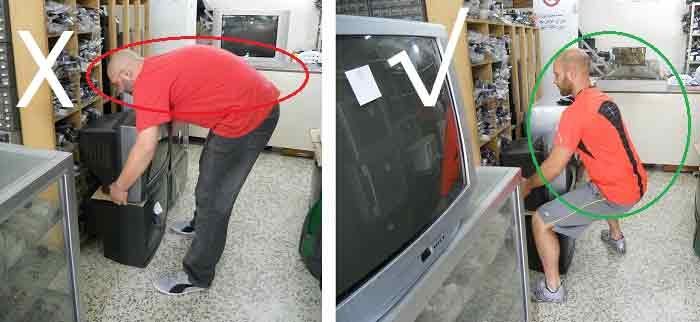
You know not to bend over to pick things up, but you do it. Every day. Hundreds of times a day.
Instead, when you crouch for things, keep your body mostly upright. You already know that. But do you do it?
Are you avoiding it because your legs are too weak, or it hurts your knees? Done right, it will prevent both back pain and knee pain. The key is knee positioning to keep body weight on the muscles of the thigh and hip, not on the knee joint. Press more from your heel not the front of the foot. Practice bending knees without bringing them forward. Keep knees over the foot. It takes a little more muscles use to bend right, but good bending will give you the increased strength you need, built-in to every time you bend and crouch. See the separate KNEE PAIN article for more about knees.
Use a healthy squat (right) for all the many times a day you bend. Keep heels down. Bring knees back, not forward. Good bending (right) does not hurt knees, strengthens in healthful ways.
Stand comfortably with feet side by side. Feet are any width apart, because this is real life. You need to bend in many different sizes and kinds of places and situations.
Upper body stays mostly upright, not tilting far forward.
Keep both heels down on the floor. Don't lift your heels. Keep weight back over the entire foot, rather than forward to the ball of the foot or toes.
Both knees stay back toward your ankles, not sliding forward. Good bending saves your back, strengthens knees, and prevents knee pain at the same time.
Do not keep a large inward curve to the lower back. That was a fad in past years. It was never healthy or good biomechanics. It was an exaggerated curve and caused many problems of its own. More about neutral spine and why this overarching is another major contributor to another kind of back pain is summarized below, and in full in the article "Back Pain With Long Standing and Running - What Abs Do, You May Be Surprised."
Good bending gives good lengthening of the lower spine. Good bending with a healthy squat is a superior lower back stretch compared to bending over forward to touch toes. More on that follows.
How To Use Squats To Fix Your Back
Is it not an exercise that you do 10 times a day. It does not fix anything if you do it as an exercise then go back to bad bending the rest of your day.
You use it as healthy bending instead of bad bending for all the hundreds of times in every day that you crouch and bend and reach down for things. Then you do not move in a way that injures and hurts. The squat is completely misused when it is given as an exercise to do 10 times a day to strengthen, then return to bad bending after.
Using good bending throughout the day gives a healthy "moving stretch." It is highly effective as a stretch and movement re-trainer. It is better than rigidly holdIng static stretches, or doing slow squats as reps of rehab or gym exercises. Real bending using a healthy squat for the things you need to do every day makes effective warm-ups and can loosen tight hip areas, all built-in to your real life.
"Fitness" people love to debate how deep to squat, and exactly what joint angle to hold your body, and ignore real life - dozens, even hundreds of "good bends" needed of various heights and foot placements to reach and retrieve things every day.
Stop hurting your spine and muscles with bad bending and your back will stop hurting. Start strengthening your body and legs with good bending and you will get free exercise all day.
Good Bending Using The Lunge
Like the squat, use the lunge to crouch instead of bending over forward. Done right, you can prevent both back pain and knee pain. It gives you free leg and back exercise and stretch at the same time. Use the lunge for daily bending.
The lunge is another way to bend well (left) for all the many dozens of times you bend every day is a lunge.
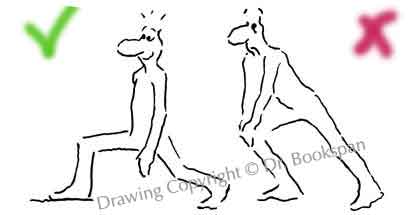
Keep front knee over ankle (left) not forward (right drawing). Width of feet depends on what you need to reach and your surroundings. Use this for real movement.
Stand comfortably with one foot in front, the other comfortably back, any width apart that you want to practice with. Keep the back foot facing straight forward, not turned out.
Tuck your pelvis and hip under until vertical, to reduce your lower back inward curve to a smaller curve. Vertical pelvis is an upright line at the side of your body from top of your leg to middle top of your side hip bone. If you look at a side seam on your clothing, it will be straight up and down instead of tilted.
Neutral spine will stretch the front of the hip IN THE REAR LEG. If you do not feel the front of the hip in the rear leg getting nice stretch then you are doing it wrong. More about neutral spine follows below. A lot more information about it a is on the "Fixing Swayback" page.
Bend both knees to dip towards the floor as far as comfortable, without touching the floor. At least dip down a few inches.
Don't let your front knee slide forward. Keep your front knee over the ankle. This is an important part of using the lunge to save your back - you shouldn't hurt your knee. Done properly, the lunge strengthens and protects your knees too.
How To Use Lunges To Fix Your Back
Is it not an exercise that you do 10 times a day. It does not fix anything if you do it as an exercise. You use it for all the hundreds of times you bend and reach down in a day instead of bad bending. Real lunges (healthy crouching) to pick things up around the house and workplace becomes a highly effective"moving stretch" and movement re-trainer, better than stiff slow lunges as gym or PT exercises.
Stop hurting your back with bad bending and your back will stop hurting. Start strengthening your body and legs with good bending and you will get free exercise all day.
Unless you are moving in healthy ways for your real life, it is not a lifestyle and it is not healthy. Healthy bending, sitting, reaching, sitting, standing, and moving is easy and life changing. It is free exercise and injury prevention. When should you do it? Each time you want your daily life to be healthy.
A month after taking my Fix Your Lower Back Pain Class, Marianne R. wrote:
"Dear Dr Bookspan, Please add my name to the list of happy people with happy backs! I've been doing stretches and bends as you have instructed and my lower back and hips are delighted!! I know how much stronger and what better form I have when I go to work on my own clients and am not hurting during or after. Many thanks, Marianne"
3. Why Yoga Forward Bends Are Like Lifting Packages Wrong
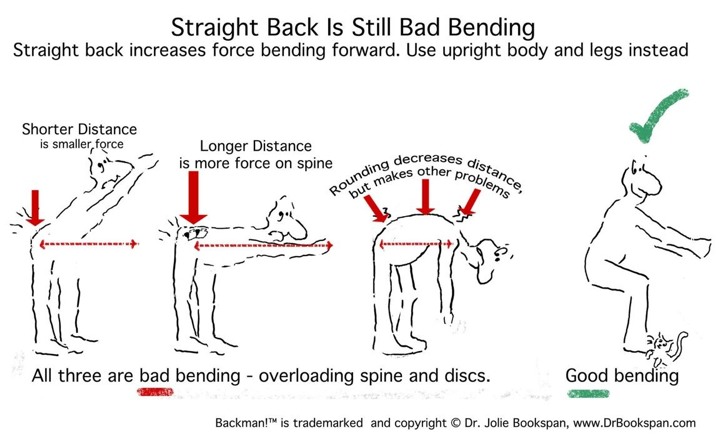
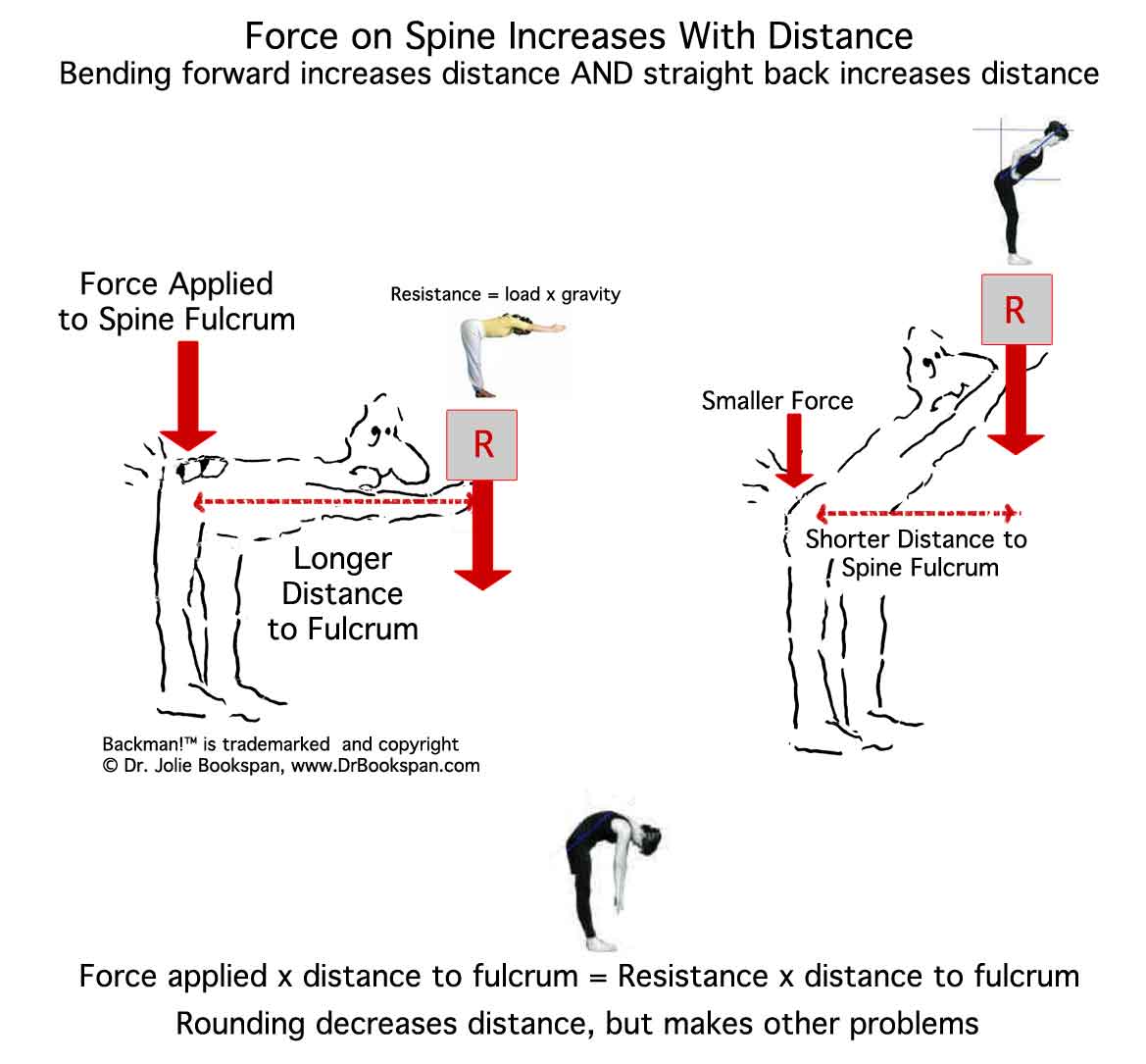
Another place to stop bad bending - your exercises. Most people know that rounding your back a lot is unhealthy. Armed with that, they leap to the idea that the opposite will automatically prevent problems. It doesn't. Bending forward with a straight back adds to load directly on the lower spine, especially discs.
Loosely straightening an overly rounded spine does good things when you are sitting or standing upright. When you bend forward either rounded or straight, you increase injurious leverage on the lower spine. Leaning forward with a straight back increases the force up until reaching maximum at a horizontal position - the hip hinge position. The taller you are and/or the longer your torso, the greater the force on the lower discs. It can strengthen muscles but can strain them and wears at the discs. Injury accumulates over years. There are many good ways to strengthen back muscles get size and back health without hip hinges.
More about yoga on the Yoga class syllabus.
There are no hip hinges that are good for discs.
Please mentally adjust the hip hinge drawing (second from left) to include the several variations of hip hinges.
Use the general CONCEPTS for healthier ways of moving and bending.
Here are some principles to explain more, for those who want it
Thank you Extensionyoga.com for the instructive yoga figures in black.
What to Do? Healthy Bending With Upright Torso
Use good bending with the half squat, shown above, instead of bad bent-forward bending, which is one of the major contributors to lower back pain. The upper body stays fairly upright, and the upper spine does not round or hunch. There is no exaggerated inward curve to the lower spine, which was a fad in fitness gyms for a decade or so. More about all the back pain that fad caused is in the Hyperlordosis and Abs article. Good bending, as shown above, gives a daily, natural, built-in stretch to the Achilles tendons, calf, hips, and lower spine.
Diane Wendling wrote:
"Thank you Dr. Bookspan. I hurt for 30 years and now I don't.
I can't believe in all my years, no other doctor has ever mentioned this type of treatment. Thank you so much!"
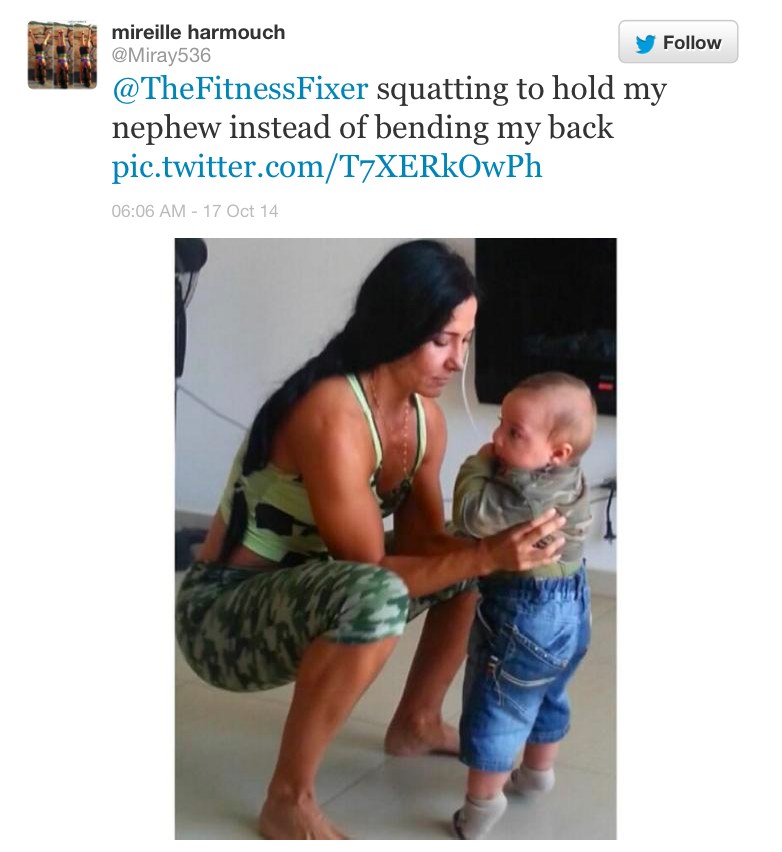
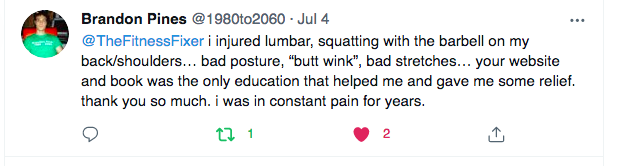
Below is a nice note from a reader on my former Twitter column.
If you don't have an account, it will say I have no posts. There were many when I used to post. If you want want to see it, it is is supposed to be preserved on https://xcancel.com/thefitnessfixer.
Hamstring Stretch Without Forward Bending
You don't need to bend over forward to stretch your hamstrings.
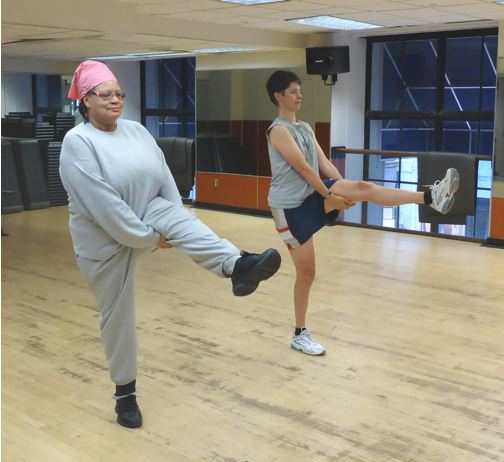
Stand upright and lift one leg. This is one of several better, more functional ways to stretch hamstrings. "Functional" means that you stretch them in the way you need for real life hamstring range of movement, not by bending over. More about this is on my Stretching Smarter page.
Stand upright to stretch hamstrings. Better for your back, and helpful balance training.
Notice both your feet. Make sure your feet are both facing straight forward, not turned out, even a small amount.
Lift one leg, knee straight.
Make sure the foot you are standing on is facing straight forward, not turned out, even a small amount.
Lift the other leg to any height that gives the intended stretch.
Hold your leg up with your hands if that helps you get more height until you strengthen enough to hold your leg up without hands.
Notice now tempting it is to use bad habits of bending over forward, rounding your back, and other slouches that reduce the real stretch - on the hamstrings. Practicing to stand upright is one of the purposes and benefits of doing this hamstring stretch in a functional way.
There are studies, besides my own, that find no helpful relation between hamstring flexibility and lower back pain. Click the Hamstring Page to see why it is so often mistakenly prescribed for back pain.
Tight hamstrings are commonly thought to contribute to back pain. Even though that is not so, the irony is that many hamstring stretches are done in ways that bend forward, putting degenerative forces on the discs. Leaning over at the waist, both standing and sitting, for toe-touches does stretch your back and hamstrings, and may feel good, but is not good for discs.
This is true even for yoga stretches where you bend over forward sitting or standing touch toes. Most people know not to bend over like that to pick things up or sit like that at your desk. It doesn't magically become good for you by calling it a stretch.
For better understanding of bending over for yoga stretches, click the Healthier Yoga page.
4. Lower Back Pain After Long Standing, Running, Walking.
Facet, and SacroIliac (S.I.) Pain
If you have lower back pain during or after walking, running, backpacking, and feel you need to lean or bend over forward or lift one leg to stop the pain, this kind of pain is usually from allowing too much inward curve in the lower back. Summary follows below. Read the full article here to understand why and know how to spot and fix this common hidden source of ongoing back pain that seems to come with standing and relieved with sitting or lying down or bending over.
Standing with too much inward curve of your lower back is called swayback and hyperlordosis. "Hyper" means too much and "lordosis" is the lumbar inward curve. Sometimes people say "lordosis" to mean too much curve too. Then confusion comes when people use the two different words to mean the same thing. I will use "hyperlordosis" or swayback to distinguish. Hyperlordosis (overarching) is a major cause of "mystery" back pain and injury.
Hyperlordosis is not a structural problem. It is a slouch; a bad posture. You create hyperlordotic posture in two main ways.
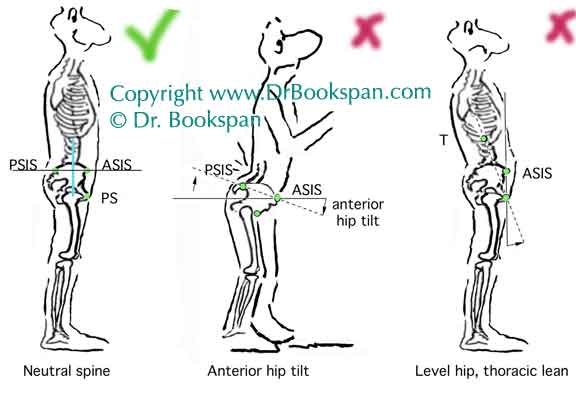
A common way people increase the lumbar arch to hyperlordosis is to lean the upper body backward when standing, reaching overhead, and lifting things. A second way is to tilt the pelvis forward. Some people do both at once. Both drawings below show standing in hyperlordosis (swayback posture):
Two kinds of swayback (hyperlordosis, too much lumbar inward curve). Left - tilting pelvis and leaning upper body backward. Right - level pelvis but pushed forward and leaning the upper body backward.
Swayback compresses the lower spine. Pain is usually noticed after standing, walking, or running. Stop pain with neutral spine, explained in the Fix Hyperlordosis article. No strengthening exercise will do it for you. It is a voluntary, deliberate change in how you stand and move.
Hyperlordosis, also called swayback, is an increased inward lower back curve (arch). Also called“swayback” or too much lumbar arch or too much lumbar inward curve.
Swayback compresses the joints of your spine, called facets, and surrounding soft tissue. The weight of your upper body slouching onto your lower spine creating a feeling of ache, pinch, and or pressure. The ache goes away immediately in many cases when you reduce the large curve - as often occurs when sitting or lifting a leg or lying with knees bent. These are not cures and are often mistaken for things to do, instead of obvious diagnostic markers.
Another hidden way that overarching (swayback/ hyperlordosis) hurts is when an existing bulging disc becomes squeezed by the spine bones as they angle toward each other in bad positioning.
Hyperlordosis is not a medical or structural condition. Hyperlordosis is a posture you can control by using torso muscles to move your spine away from the arched position into a straighter healthier position, described below and in the free Fix Hyperlordosis (abs) article.
"Hyperlordosis of Pregnancy” is the same preventable bad posture. It is leaning backward to offset a load in front. Leaning backward from the lower back makes a sharper inward curve, pinching and compressing the lower spine, making the area ache after long standing.
Neutral spine is a voluntary, deliberate change in how you stand and move. No strengthening exercise or posture drills or core training will do it for you. Fix it with the neutral spine positioning shown in summary below and in detail in the Fix Hyperlordosis article.
How To Stop Back Pain From Hyperlordosis (also called Swayback and Lordotic Arching)
If you get lower back/ hip/ flank pain during and after long standing, running and overhead lifting, a common cause is standing with the lower back overly folded and tilted back so that it pinches and compresses the joints and soft tissue. People who stand with this poor position usually feel they must bend forward or sit to relieve the ache. Stretching, ab exercises, and all kinds of crazy gimmicks became confused as cures, instead of not standing wrong in the first place.
The left (first) drawing above shows neutral. The second shows tilting the pelvis forward (the backside tilts outward in back). The third shows a level pelvis, but hyperlordosis from leaning the upper body backward. I spent many years identifying these (hopefully now obvious) painful positions.
One easy way to feel how to change to a more neutral spine position:
1. Stand with your heels, backside, upper back against a wall. Notice how much curve is in your lower spine and how far that inward lumbar curve is away from the wall.
2. Press the lower back area closer toward wall. The large space between your back and the wall becomes a smaller space. No need to completely flatten against the wall.Just use it to learn the movement needed to reduce the large curve to a smaller one. Belt line becomes horizontal from front to back. Back pain from overarching should stop right then, if you do this right. Make sure you can relax and breathe and feel that this is a motion of your spine, without any tightening of your abdominal muscles or your gluteal muscles.
3. When you walk away from the wall, use this new neutral spine position all the time as a relaxed healthy position.
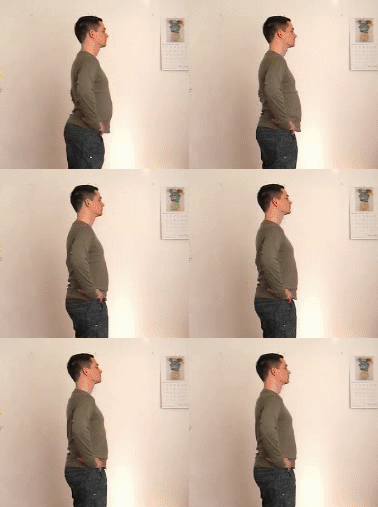
A short gif should appear below of one of my students, David of Belgium. He starts with overarched lower spine, mostly from the tilted pelvis, then shows reducing the overarch (hyperlordosis) to neutral spine by moving the pelvis to vertical.
Note: Watch the lower spine reduce in inward curve. The pelvis changes from tilted to vertical. Do not push the pelvis forward of the midline. The knees (off camera) do not bend. Practice so you can move your spine without needing to bend the knees.
Remember
Use your own muscles to reposition your spine, during all you do, all the time. Not tightening, but simply moving out of unhealthy position to comfortable healthy position.
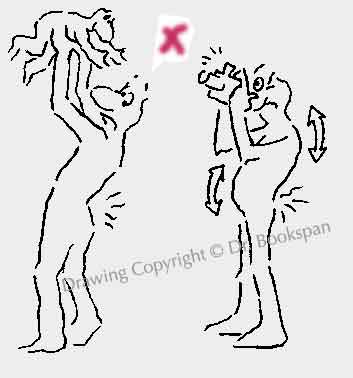
Don’t lean your upper body back when carrying things in front of you (anterior loads) like a chair, grocery bags, a pet, or baby.
Don’t lean back when lifting or reaching overhead.
Don’t let bags or loads pull your posture away from healthy position. Use your muscles for comfortable healthy pain free positioning.
Crunches and ab exercises do not change swayback, or fix the cause of this kind of back pain. How you stand and move all day is what determines if you are putting your lower back into a position that folds it so that your lower back hurts.
My abdominal article tells more of this method, with more GIFs. My book The Ab Revolution teaches several ways to learn to fix swayback (to reposition your torso, hip, and lower spine) and how to use the repositioning for all you do in daily life and for healthier more effective exercise.
Aren't You Supposed To Overarch The Spine, Tilt The Pelvis, and Stick Out Your Backside?
A small inward curve belongs in the lower back. Unfortunately, people hear that, and overdo. Overarching is not the normal curve to the lower back, it is not neutral spine, and it is not the way to protect your back when lifting or exercising. An injurious phenomenon in fitness and "health" magazines is to stand and exercise with the hip and behind tilted out in back, and the lower back overly arched. It is not attractive because it is not healthy. It is sloppy posture, unhealthy for the lower spine, and shows a lack of understanding of how to use core muscles to hold neutral spine.
Overly-arched posture is promoted by popular fitness personalities and popular exercises where it is mistaken for, even advertised for, fitness and trimness. Trainers often tell clients to stick their behind out when squatting or lunging, however this is too much arch. The hyperextension is damaging over time to the low spine joints and soft tissue. It also does not use core muscles effectively.
What Do Abs Have To Do With This?
Abs work like any other muscles - they bend the joints they cross. For example. biceps bend your elbow forward (or keep it from straightening). Abs cross your vertebrae. They bend your spine forward or keep it from swaying backward, but only if you voluntarily use them. Using abdominal muscles does not mean to tighten them. Tight muscles can't do their job. You wouldn't want to tighten your leg muscles and try to run. Or tighten your throat and try to sing. You use abdominal muscles to move your spine. That's all. You need to deliberately use your abs while standing to hold you from backward arching, particularly when reaching overhead and carrying loads.
Using Abs (Or Any Muscles) Does Not Mean Tightening Them
Using your abs doesn't mean “sucking them in” or making them "tight.” You can't breathe or move properly with tightened muscles. Tightening does not change your posture or reduce the pain-producing arch.
How Do Abs Help Your Back?
Using your abs means voluntarily moving your spine away from overly-arched position, and into neutral spine when standing. It is not a matter of having strong abs. A slightly-built person can stand with neutral spine, and muscular people can have overly-arched spine posture. It is a matter of using abdominal muscles to prevent the overarching that causes pain. My book The Ab Revolution™ teaches this concept and shows how to use it during all daily life and exercise movement.
Doesn’t Doing Crunches Help That?
It is not strength that makes you stand correctly. It's how you hold your own posture. Many muscular people stand with terrible posture and have back pain.
Crunches don't work your abs the way you need for real life standing up.
Crunches don't train you how to use your abdominal muscles and core the rest of the day to control your spine position. They don't do it automatically.
Crunches reinforce rounded flexed posture, even when done properly.
Crunches make a person, who likely spends much of their day already hunched over a work area, practice that hunched posture which may be mechanically promoting the back and neck pain they think they are working their abs to prevent.
Most people do their crunches then stand up arched with no knowledge that back support comes from voluntary posture, not automatic strengthening.
What About Pelvic Tilts?
A common exercise often given for back pain is to lie on the floor or stand, and tilt (tuck) the hip and pelvis 10 times (or any number of "reps"). The claim is that these minor motions strengthen the area, with the further untrue claim that strengthening will stop the pain. When you really look at it, the effort of pelvic tilts is miniscule and not near anything that can strengthen. Moreover, this kind of pain is not from weakness, it is from standing in swayback. Often, the person finishes their pelvic tilts, then stands up and returns to the same swayback (slouch) that causes the pain. Pain returns. It is no mystery.
The purpose of the pelvic tilt "exercise" is to practice how to move your spine and pelvis out of the overly arched position that causes pain, into healthy neutral spine (tucked just enough to be neutral). Then you must *use* that neutral position (that you just practiced) for all your standing movement.No tightening or strengthening is involved.
Tilts do not strengthen. The movement is too minor and low resistance.
Even if tilts strengthened, back "support" is not automatic. Strengthening any muscles will not a bad posture which causes pain.
Stronger muscles do not automatically move any body part anywhere. You have to move yourself into desired posture.
The use of pelvic tilts is to retrain how to reduce your lower back position. Then use that knowledge to move your pelvis/ lower back into neutral position when standing.
-----
A patient insisted to me that her pelvic tilts "worked" and fixed her pain because they strengthened her core. When I asked her when she felt the pain go away, she said when she was lying on her back doing them. Of course lying down with your knees bent and taking a painful arch out out of your lower spine makes you feel better - for the moment. I asked her if the pain came back eventually, she said, "Of course, when I walk too much." So the pelvic tilts did not really fix anything. Strength was not the issue. Standing and walking in poor overarched lumbar posture was the problem. Once you learn your pelvic tilt, don't do it 10 times, you only need it once - to move to neutral position. Then use neutral - while standing, while walking, while running. (No tightening - any more than you tighten your arm to scratch your nose or tighten your legs to go running.) In other words, pelvic tilts don't work from doing them 10 times as an exercise. Do one pelvic tilt standing up, and use that new neutral position for real life, not as a set of exercises
-----
Strengthening and stretching are important, but do not change posture or lifting habits, and so, do not “cure” back pain or posture problems. Often the pain was not from needing more strength or flexibility.
I redesigned back exercises to be used to retrain you how you hold your body all the time. Use these new ideas of voluntary healthy movement habits to stop the source of your pain.
Doing back exercise is not like getting a shot of penicillin or going to confession. It does not “fix” bad habits the rest of the time. For example, lying down for pelvic tilts, but then standing up and letting your back flop into any old bad posture, not keeping the proper tilt. Instead, use back exercise to retrain your thinking and habits *all the time* not merely something to "do 10 times." Strengthening has no effect on posture if you don’t apply the strength the rest of the day to control joint angles for all activities.
Better Abdominal Muscle Exercises
My separate article on fixing back pain from swayback - the ab article shows how to to retrain lower spine positioning away from painful position. It gives gives introductory exercises that you do using this new healthier position, to get exercise and also practice positioning. Then you transfer this new positioning knowledge during when you walk and go about your day. If you only use abdominal exercises as reps and sets of an"exercise," that is missing the point.
More exercises to retrain abs for daily life and back pain rehab are in the book, The Ab Revolution™ No More Crunches, No More Back Pain. Also come try my Ab Revolution classes.
Don’t Exercise in Ways that Damage Your Back
Many people hurt from excessive forward bending. Then add many exercises with more forward bending - toe touches, knee to chest, most Pilates exercises, and crunches. Often these exercises are incorrectly prescribed for back and neck pain. They contribute to the original problem of over rounding and bad posture. Stop crunches. Use my ab techniques to get good exercise without needing the kind of flexion that is hard on discs. See my page on Abdominal muscles. More about Discs on the page for Fixing Discs and Sciatica. Here is my summary on bad exercises. Click the class page for my ab classes, back classes, and yoga classes that teach healthful movement.
I am working on an expanded section on spasm of the back muscles. Until I can do more, here is an overview:
Spasm is a sudden pathological involuntary constriction of one or several muscles. Spasm is more than a cramp or tightness. Unlike a cramp that can be relieved with stretches, spasm does not stop. It interferes with normal muscle function and chemistry in a self-sustaining cycle of pain and injury. Even small spasms can be painful. Some can be debilitatingly painful. Spasm can co-occur along with strains, tears, blunt trauma, and other injury, each with their own pain and problems. Spasm should not be left. It is not an injury that heals itself with time alone.
Causes aren't known in all cases. Unhealthy body movements that ordinarily would only strain or pull a muscle or make it ache sometimes result in spasm. Existing and new areas of irritation or injury may be more vulnerable. A sudden large impact can overload even healthy strong muscles. There are illnesses, injury, and nutritional problems that interfere with muscle chemistry making them likely to cramp or spasm, or impede a cramp from getting resolved.
According to the Association of Ringside Physicians, there are reports that dietary supplements such as creatine might increase risk of muscle cramps.
Does Spasm Injure? Some practitioners say that pain will not injure the muscle so it's not consequential nor a concern. There are many counterexamples. The muscle remains electrically irritable, with reduced blood flow and ability to move wastes in and out, and interfering with chemical cellular functions. Spasm is an intense pain that greatly limits ability to move, breathe deeply, do self-care, exercise, eat properly, have social activity. Reduction in balance, speed, cardiovascular level, muscle, and bone is detrimental to physical condition and health, and predisposes to further injury and pain. It is healthy to treat spasm quickly.
Muscle Relaxing Medicines. There are times when a relaxing agent and a separate anti-inflammatory are needed to quickly stop a pain-spasm cycle.
Muscle relaxers can, and often do relax a spasm over a few days. They do not have effect on non-spasm pain, not surprisingly. There are unfortunate errors in evaluating the literature on muscle relaxing agents. Some pain medication studies report that muscle relaxers show "mixed" results when the issue is when they do not separate effect on true spasm from little to no effect on regular strain and injury pain. Spasm can co-occur along with strain and other injury. Relaxing agents help the spasm while anti-inflammatory agents can reduce pain from the rest of the injury.
There are some classes of relaxers that do not act on the muscle to relax it but reduce pain signal to the brain. Some classes of these drugs are not limited to muscle but overall depressant including mental functions. My opinion favors the classes that directly act on the muscle.
Muscle relaxers are not ever intended for long or extended use.
Does Stretching Help? Stretching can usually quickly reduce a cramp in the leg or arm or your sides. Spasm of back muscles can cause such intense pain and tightness that it is difficult to move at all. Stretches can irritate and continue the spasm cycle. Keep moving gently, as much as possible. Use heat to help loosen.
Sometimes a more minor back cramp or tightness can be relieved with specific brief gentle stretches that directly lengthen specific muscle(s) in line with how they are shortened. This leads to misconceptions of magical poses for back pain.
Or a stretch that should be used only on the rare occasions needed to take out a cramp is mistaken for something to do daily, like forward bending stretches, which when done all the time cause their own kind of back pain (Disc Pain article). Or there is so much muscle strain that the stretches themselves hurt.
Yoga Triangles
and twists are examples. When used for a brief stretch - meaning two to three seconds at most - and not forced too far, can give a nice range of motion, give a brief healthy spongy movement to vertebral discs. If a tightness or spasm is down a specific side area, then a brief 2-4 second Triangle (simple side bend, no yoga classes needed) or specific direct gentle twist if specifically lengthening a spasm shortened in line with the twist, could release it - used as a one or two-time application. Random lists of yoga stretches may or may not lengthen the area needed. When triangle and twist poses are regularly done and maintained static for the long periods of time held in many classes, they put sheer force on the discs (a large component to herniation) and restrict circulation. Regular long side bends, forward bending, twists, and triangles are not needed or healthy. Standing with too much inward curve in the lower back, for example, keeps lumbar muscles in a shortened length, not their needed resting or functioning length. They may become too tight and stiff to be comfortable.
A forward bend often feels good when it lengthens a shortened area, such as a lumbar spine chronically shortened from standing in a bad posture of swayback (hyperlordosis). Forward bends become erroneously accepted as a cure, when not standing with swayback (the too large inward curve) would be the actual cure, and the forward bends a poor and unhealthy antidote. For an acute tightness, a lengthening bend can release it, if done right. If you continually go back to bad habits that make pain return, and claim you have to do yoga or other stretches every day to fix it, then your yoga or treatments are not fixing the causes. However, constant forward bending is one known contributor to back pain and injury. See the Yoga Page for more.
For more on why hamstring flexibility is not related to back pain, or required to relieve it, see the Hamstring page. A lower back stretch that is functional and feels great, and also can lengthen a shortened tightened lower back is ordinary good bending using the squat, explained above in sections 2 and 3. A full squat with both heels down on the floor, done right, can be a good and healthy lower back stretch. Student and regular success story contributor Robert Davis, demonstrates full squat with both heels flat on the floor, body fairly upright, in the photo above right. He also made us a video demonstrating using a simple half and full squat for picking up things around the house - to view Cardiovascular Cleanup, click the Functional Fitness as a Lifestyle page.
Foam rollers, tennis balls, and assorted pricey devices are over-sold as cures. Sometimes people manage to randomly press the right place with them which accidentally lengthens. For general use, they may not do anything physiological or for health. If you like them just to feel good in general, you don't need any invented sham reason to enjoy using them.
Surgery. Spasm can hurt terribly and limit ability to function. When people who could have benefited quickly from a brief course of relaxing agents go for medical scans, sometimes a disc or other injury shows on scans that may not be the entire, or any, source of the pain. Important to differentiate.
Food cures. No one knows cause and chemistry why muscles sometimes tighten so much and do not want to let go. Lack of knowledge brings huge marketing offenses of sham cures of various pills and foods. It seems known that cause is not for lack of bananas or most other foods. Sometimes spasm goes away by itself, leaving whatever unrelated thing the person did or ate that day to become the next claim for cure.
Muscle "Balance" Many false beliefs use vague phrases like "muscle imbalance" and that muscles "pulling" on your various parts cause "knots." Muscles pulling on your parts is how you move - normally and daily. Muscles on one side of the part have to pull harder than muscles on the other, or you would not be able to move at all. More on this in #7 below. Muscles tightened into spasm can bunch up.
For upper back spasm - under, between, and around the scapula (shoulder blades), one common cause is the bad habit of leaning the upper body backwards when standing. The same leaning back is sometimes associated with spasm in the front muscles just below the breast. This is more common when the person who leans the upper body backwards as a bad posture, rounds the upper body forward to compensate, resulting in a habitually shortened area right there that can go into spasm. The article on Neutral Spine shows how to prevent the upper body lean back (I named it Thoracic Lean) and stop this kind of upper body pain. A second cause of upper back spasm is squeezing the shoulder blades together deliberately because of bad advice about posture. Squeezing shoulder blades together as a habit more often causes a pinching pain and tightened muscles. Fixing upper body positioning is often more a matter of "unrounding" the upper spine (straightening), not pulling the shoulders back (and definitely not pinching shoulder blades together). See the Neck and Upper Body Pain Fix Article on how to restore healthy upper back muscle length and position so no squeezing or pressing downward is necessary.
Sometimes a back spasm release can be like a leg cramp release - a brief direct stretch in line with the specific shortened fibers. It can be tricky when different muscles clench at once in different directions. Then you must determine the direct lengthening that briefly gets them at once. Relaxing medications are sometimes needed for a quick short course to get the spasm out so that you can let the rest heal. Check back - this section on back spasm is in progress.
Muscle "imbalance" doesn't cause pain or herniated your discs. You constantly change pulling some muscles more than others to move as wanted. Obvious exceptions are spasm, Tetanus, or Cerebral Palsy. Even with dystonia or palsy, you need to work to control the muscles all the more. A well person who is slouching due to gravity, or who is tight or uncoordinated isn't an imbalance of how hard muscles pull, but how you are able to control the amount of pulling, which grows with practice and is "use or lose" without exercise, like most other things.
Having "tighter" muscles here and there isn't "imbalance," and sometimes tightness doesn't cause anything bad, even helps hold you in position without "rattling" too loosely. If you have to strain so much that it is painful to stand up comfortably straight, then use the stretches and healthy movement skills in my stretching articles and books.
Every year, a different muscle or condition is the latest fad cause of all pain. One year it was multifidus muscles. Books were written all about how exercising them was the answer. Another year, the erector spinea were "the" answer and anyone hurting was given erector exercises and injections. Another year, sciatic-like pain was piriformis (spelled various ways) and everyone was given a stretch and exaggerated explanations of its effect on posture. The most commonly done stretch, called "THE piriformis stretch" stretches near but really does not stretch the piriformis specifically or enough. Then everyone was sure they had "dead gluteal syndrome" or "dead butt syndrome" which doesn't exist. Gluteal muscle weakness is not the cause of back pain. Other fad explanations for pain are "inflammation" supposedly from foods you eat or don't eat. Most musculo-skeletal pain is not inflammatory. Pain that is from inflammation needs thorough checking for rheumatoid disease.
Tight muscles in the lower back and posterior hip can make the lower back uncomfortable, and also press on the same or other nerves as an injured disc, mimicking radiating nerve pain and sciatica.
Posterior hip tightness can come from many common bad habits, such as habitual swayback which shortens the lower back, from standing and moving with the hip bent instead of neutral spine, common in conventional exercises in gyms and yoga studios, and lack of healthy bending and other movement that would build-in stretch to the area just from daily life (see the Fitness and A Lifestyle Page for these healthy movement habits).
Another contributor (of several) to posterior hip tightness causing sciatic pain down the leg is standing, walking, and moving with legs turned out - duck foot. Muscles that turn your leg outward are in back of your hip (in your behind). They fasten from the back of your hip bone to your upper leg bone going sideways. They are called your deep rotators because they rotate the leg and are under other muscles. The sciatic nerve (and many other nerves) passes near or through one or more of these muscles (which may be the piriformis muscle or the other deep lateral rotators that work with it). When these muscles get tight from years of walking, sitting, and standing with your hip bent, from bad walking habits of turning the feet out, and lack of healthy movement that would have stretched it, the tight areas can press and add to sciatic pain.
Another part often confused for piriformis or disc is injured hamstring attachment which is an injury to the part of the hamstring right where it attaches to the "sit bones" of your posterior hip. For hamstring tightness, see my page on Hamstrings, which shows the research on why hamstrings, tight or otherwise, are not related to back pain, and why the confusion came about in the first place.
Make sure to keep learning and understanding about all the simple but different causes first, instead of just doing bunch of exercises or stretches or getting treatments for disc, hoping that will magically fix something that you do not have. With that in mind, remember that all the following are healthy to do all the time, instead of bad movement habits that injure over time.
What To Do for Tightness
Good bending for things using an upright squat and lunge instead of bending over, builds in healthy moving stretch to your lower back and hip during all you do.
Don't do good bending as 10 squat exercises but for the hundreds of times you bend all day. Good bending prevents damage to the discs and back muscle strain, and gives needed motion-stretch which helps cellular repair.
Use healthier hamstring stretches instead of bending over to touch toes. I developed these different hamstring stretches to build in the function needed from hamstrings during running, kicking, stepping up, and other real life. They don't use bad bending. They also help re-train length in good ways that help prevent the kind of "pulls" that result in tight un-stretchy sit-bone attachments that hurt when you sit or lift the leg. They are further explained on my Hamstrings page.
Some posterior hip stretches and good bending stretches are on the Fitness as A Lifestyle page.
Several healthier stretches for tight posterior back and hip are in my books Stretching Smarter Stretching Healthier and Fix Your Own Pain.
9. X-Rays and Scans
Pain When Your X-Ray is Normal. You may be in great pain from simple damaging mechanics. Your X-rays and scans are normal. You may be told nothing is wrong, or to give up favorite activities. Your pain persists from bad postural habits. This is no mystery. Change the bad habits to change the pain.
Other times, scans show some minor problem like arthritis, herniated disc, or degenerating structures. Like car tires that are mid-life, but perfectly good, some wear may show on exam – but this is unrelated to performance or pain. Pain is falsely ascribed entirely to the arthritis. Patients feel doomed, and are often told to give up activities. Pain (even the anomaly itself) may mostly result from poor mechanics. This is no mystery. Change the bad habits to change the pain.
Sometimes, scans show some major problem, and major surgery is performed to correct it. When the original problem was from the bad positioning, often pain persists or returns because you never corrected the mechanics that caused it. The defect itself may return from uncorrected mechanics. Surgery can be avoided. Fix the source of the problem and the results of the problem can heal, usually without surgery.
Pain from Foot Orthotics
An extremely common scenario is someone who goes to the doctor with a little pain from the usual poor lifting and movement mechanics. They are prescribed foot orthotics, which a rigid molds mistakenly believed to "hold" the foot in proper position. However, consider this - they are molded sitting or lying down, not when the person is standing where they need it and when foot position changes. OR the orthotic is "custom shaped to the person's foot" which was in the wrong position to begin with. Often the orthotics are rigid and hard, which would cause pain in any case. The person get new pain in the leg, hip, which can increase to numbness, then they are told to further reduce activity and pay for PT or give up and live with pain.
Pain From Your MedicinesCommon prescription and non-prescription medicines sometimes cause back and body pain.
Are you on medicines for lowering cholesterol? Sleeping medicines? For stomach acid? Drugs for depression and anxiety? Irritable bowel drugs, stomach acid drugs (a large contributor to osteoporosis and thinning bones) drugs to concentrate, to help wake up, to calm you, for allergies. Increasingly, drugs are found to make more pain as side effect, even drugs you are taking for pain. Trying to stop them causes rebound and withdrawal pain. It doesn't mean the right medications under physician supervision aren't needed or even healthy and life-improving. More about this is on the Nutrition page.
When you reach for anti-inflammatory medicines and pills and healthy foods, remember that most back pain from bad habits is not inflammatory in nature, and may be why all those pills aren't working. Try changing the bad habits that are the cause or contributors.
Back Surgery Is Rarely NeededMy Fitness Fixer (tm) column ran on Healthline.com for 4 years. I wrote over 800 articles on making medicine and exercise healthier, and about distinguishing facts from wishful thinking. Several of my Fitness Fixer articles documented properly conducted studies that showed that, as a whole, back surgery does not improve outcomes more than not having surgery, plus the pain and bills for the surgery. When the column ended in 2010, the company removed most of my photos and all the movies I made to help understand the articles. Then they removed the articles and put my links leading to their own articles.
I found a Blogspot archive that allows use of my "label" tags to group articles of same topic. In this case, "surgery." Let me know how this link works for you:
http://healthlinefitnessfixer.blogspot.com/search/label/surgeryIt should let you see some of my articles about back surgery. It also includes knee surgery outcome articles, and retains some of the original photos, movies, and comments, but links in those articles to my other Healthline articles will not work. Healthline replaced them with their own.


Many medicines may seem to "work" at first, but are not healthy. This is not limited to only Western medicine but all practices,
"There is nothing so useless as doing efficiently that which should not be done at all."
~ Peter Drucker
What To Try Every Day To Prevent Back Pain
Count the many times you bend and stoop and reach downward for things each day. Add the large number of forward bending exercises, crunches, toe touching and most Pilates and yoga moves done bending over. Most people do not need more forward bending any more than they need a Tetanus shot every day. Understand the cumulative damage to your back by bending wrong that many times each day.
Instead, lift and bend for everything using a healthy good squat or lunge (different foot positions for how you need to reach different things), not by bending over. Avoid exercising with moves that are bent over. Use healthier exercises instead. Some samples are on the Disc page and the Abs page.
My Academy student Nahy Milad Bassil demonstrates changing bad bending to good bending.
Notice bent forward and hunching positioning and exercises in fitness magazines. Then notice your own habits.
First thing in the morning, don't sit on the bed. Instead of sitting and rounding your back first thing, turn over and lie face down. Prop gently on elbows, but not so high that it strains, pinches, or hurts anywhere. Don't do this if it hurts. It should not hurt to simply lie straight. It should feel good and help you straighten out first thing. Get out of bed without sitting.
Don't hold rigid "good posture." Healthy movement is dynamic. Stopping back pain does not mean never moving the spine, or holding it in some posture. Healthy motion is crucial for health.
Stand and carry things without rounding your upper back forward or leaning the upper body backward (exaggerating lumbar curve to the back or side). More on swayback in the Abs article and the Healthy Lifting and Carrying article.
When sitting, it is not true that you must "keep feet on floor" or keep “flat thighs” - parallel to the ground. That is often repeated, but it does not change injurious mechanics, and is not needed. Focus on the main issue not the trivia. Learn more about this in the no-charge Sitting Healthy article on this web site.
Learn to restore healthy upper back muscle resting length using the no-charge Fix Upper Back and Neck Pain article on this web site.
Don’t tighten your muscles to move or exercise. Gluteal and ab tightening is a pop fitness fad, not healthy medicine or exercise. Tightening impedes movement and makes you feel tight and uncomfortable. You don't tighten your throat to sing. You don't tighten your arm to scratch your nose. You don't tighten your legs to run (or shouldn't). Learn to move your torso into healthy positioning without tightening your abdominal or gluteal muscles, or any muscles.
Walk, run, and jump lightly. Your body and cells, and especially your bones, needs motion and impact for health and growth. However, banging down without any shock absorbing action by your own muscles can jolt your joints, especially if your positioning and mechanics are not good.
Make sure your pain is not from medical conditions (vascular, infection, shingles, Lyme disease, Sickle Cell Anemia, other) or from many medicines known to have body pain as side effects
These Methods Work Only As Written and Intended
Henry Louis Mencken said, "Any man who afflicts the human race with ideas must be prepared to see them misunderstood" Even so, try each thing as intended. This work is different and works differently. I wanted that to be a good thing.
How Long Does It Take To Fix Back Pain?If the cause is positioning, you should begin to feel a positive difference as soon as you start using everything above as presented and intended. As you continue to stop causes, the injured areas can continue repair and feeling better, a little more all the time. Progress may not be a straight line but it should be definite. If you're not feeling better right away, check the following:
Stop and assess. Check what you are doing compared to what is presented above. None of the above are "exercises" to "do" - they are retraining drills to learn to stop doing the things that injure.
Are you doing bad exercises from other sources? It is common to do a few good movements, but continue or add common injurious exercises, stretches, and posture rules that slow recovery and re-injure.
Are you tightening or clenching any muscles? Tight muscles can hurt and impede healthy movement.
Are you overcompensating? Are you making new bad movement habits that seem opposite of original unhealthy movement, thinking that will "undo" or fix?
Are you going back to bad movement habits during the day? Check my free article on bad exercises, this one on bad stretches, and this one showing better health and understanding what abdominal muscles really do to fix back pain.
Is something else causing the pain, such as injury, infection, shingles, growths, Lyme disease, allergies, Sickle Cell condition, too tight clothes or equipment, a bed that is too hard, side effects of medicines and supplements you take, or other non-musculoskeletal conditions?
It takes years to hurt a disc and practice injurious muscle habits, but only days to start repair once you no longer are injuring yourself. Make sure there is not something else contributing to your pain. It is is almost always quick and easy to start getting your life back and start feeling better right now. Don't wait.
Success Story To Remember To Fix Right AwayHere is a charming e-mail sent to me from Joan J.
"My back hurt so bad I had to walk hunched over or not walk at all. My friend advised me to see a chiropractor. So I did. He took $82 a week to adjust my back twice a week and my insurance didn't cover it. He reassured me my pain would get better with treatment. So I kept going until my savings were almost gone :(
"In desperation I turned to the internet and finally found Dr Bookspan. She explained how to fix my horrible pain and she didn't charge me a cent for her article! I was so grateful that I send her a donation. Later I sent another one, when my back reminded me that I stopped standing right. I straighten the way Dr. Bookspan showed me and the pain goes away immediately. The funny thing is my back has learned its lesson so well I don't need to send her a Thank You donation anymore! Hmmm. That doesn't seem right."
~ Joan Johnston"
Joan runs a sanctuary for abandoned animals where she rescues, treats, and finds homes for them. I told her she could put her next donation toward their care where it will help animals and people be happy together.
RAP Song to Help Remember Good BendingHere is a fun rap to remember good bending as one of many components of back health. Rap lyrics by Dr. Bookspan. Rapped for us by Raymond Lott, former United States Marine Corps sergeant (RSonic, The Marine Rapper), who served combat tours with infantry battalions in Iraq 2006 and Afghanistan 2008. He made me these videos to help the world fix pain.

If this Rap for Good Bending does not load, try the direct link on my Flickr page:
https://www.flickr.com/photos/39972966@N03/14470852384/
Summary
Back pain is not a mysterious "condition." Some people spend their day sitting, working, walking, and driving in terrible positioning, hunching over the computer, lifting and bending wrong all day, walking heavily, standing and walking with too much inward curve in the lower spine, slouching all day, then exercise in ways that strain and pressure discs and muscles and deliberately train injurious movement habits like overarching and bad bending. People do yoga and Pilates that forcibly pushes discs outward, and reinforces flexed (bent forward) hip and forward bending. They take anti-inflammatory medications for mechanical pain that is not inflammatory in nature, try remedies that do not address the cause of the problem, do physical therapy in ways that exacerbates the original problem, give up favorite activities, have surgery, then return to previous injurious habits, and everyone is astonished that they "tried everything and nothing seemed to work." It is like eating butter and sugar all day, then waving your hands in the air for 5 minutes and saying "I don't understands why I don't lose weight, I do my exercises."
Use healthy positioning to stop the cause of disc damage and muscle pain and they can repair themselves. Then, no need for pills or surgery or adjustments.
Does my work mean you never do any flexion? Of course not. That is not healthy either. The idea is to notice if you spend most of your day bending in unhealthy ways, in daily life and during exercise. Then it is no mystery why you hurt.
Instead of memorizing rules and postures and thinking that an exercise or kind of exercise will fix back pain, understand what healthful movement needs and then move accordingly for all you want to do. Use your muscles to reposition for daily life - to get built in exercise. That is exercise as a lifestyle.
Please don't combine popular injurious stretches and exercises then come back to me and say my work isn't fixing that.
Exercise as a lifestyle does not mean going to a gym a few times a week. It means how you move all day in real life. Get exercise as a lifestyle through all-day healthy movement, so your back can mend, and you can do more than before. People love to go to a gym to exercise their abs, then go back to hyperlordosis for daily life. If they maintained neutral spine instead of swayback, they would not have the pain and would get healthy abdominal use all the time.
Exercise may not fix back pain from painful slouching, but it is good for you in general. It is crucial for your health and recovery. Not all exercise is healthy, just like not all food and medicine - there is junk food and unhealthy medicine. Use my work to understand the concepts so that you can tell what is healthy movement. Then apply it to your life - happy, healthy, active.
If your lower back pain is from too much inward curve to the lower spine (swayback, also called hyperlordosis), then stopping that slouching posture and changing to neutral spine will feel better right away. Often people "tuck the hip" too much, or tighten, or push their hip forward instead of changing the tilt, then claim neutral spine is wrong or does not work. The Abs Article tells more. Use a side view mirror and learn to feel and tell how you are moving your body and how to change a swayback to a neutral spine. If your pain is not from a too large inward curve (swayback) then check for other unhealthful movement patterns you may habitually do, and change those, simply, without straining or forcing
Please do not e-mail me saying you are "doing the exercises 10 times" and want me to tell you how to fix pain from bad positioning and bad bending. Doing an exercise then going back to unhealthful body usage can't fix pain from unhealthy body positioning. Stop bad bending and unhealthful positioning and habits. Stop the causes and that source of pain can stop. This free article summarizes. My books tell more.
How is your body positioning right now? The benefits of exercise and therapy are missed if you don’t consciously use healthful positioning the rest of the day for standing, sitting, bending, having fun, and all you do.
PATIENCE PROLONGS A CRISIS.
How long do you want to hurt?
Stop injurious positioning today. Don't wait.

Matt R, pictured above at the top of Cape Lookout Lighthouse, wrote shortly after working with me to fix a badly injured disc in May 2015, "Here's some information about the Lighthouse to add to the story of what I'm doing instead of the back surgery the doctors said was required. Thanks to you I don't need the surgery. I thought the warning from the Lighthouse web page was kind of fun... ''Warning: The climb to the top is strenuous. It may be hot, humid, noisy, and dim inside the lighthouse. Climbing the 207 steps to the gallery is roughly equal to climbing a 12-story building.'" Matt has been hiking, climbing, and skiing since then, pain free and mobile.
You Don’t Have To Live With Pain
What To Try Next
Throw a few dollars in the donate box to keep this site running? Secure through PayPal. Thank you!
Take the money you saved on medicines, treatments, depression, and surgery, and take a vacation. You'll still have enough left over to give to the poor. Your happy e-mails of successes thank me.
Help This Site Without Donating Anything
Click any links from my books to Amazon to get anything else, whether it's my books or not. Amazon will send this site a (very) small percentage of purchases (not clicks) - anonymously. Get song downloads, groceries, health and medical equipment, home stuff, movies, whatever. Your name is never given to me. Larger purchases send more, so get your next computer or playground this way, too. Thank you for helping this web site by shopping for things you get anyway. Proceeds go running this site, class scholarships, free world health programs through my Academy, donations to world need causes. Use the links for next time you shop, too. Have fun.
Books and eBooks All my books together cost less than your pain killers, and show you how to stop needing them. Fun, easy to read, illustrated, immediately helpful
Don't worry about people stealing your ideas. If your ideas are any good, you'll have to ram them down people's throats.
- Howard Aiken
That said, Be Healthy - Respect Copyright
This article is copyright and here to benefit the world.
Information, drawings, and photos are © protected copyright. To cite this article or any parts, list author Dr. Jolie Bookspan and link to this site. A suggestion to get my books is also nice. No Derivative Works License means no changes to content, wording or links.Drawings of Backman!™ copyright © Dr. Jolie Bookspan from the book Stretching Smarter Stretching Healthier, Fix Your Own Pain, and others.
More LEGAL and Reprint Info.
If this article fixes your pain, send it to a friend (the article,
not the pain).
HOME || The Ab Revolution™ || Academy || Adventure Medicine || Bio || Books and eBooks || Bookspan Basics || Classes || Diving Aerospace & Hyperbarics || Emotional & Mental Fitness || Fix Your Pain Articles || Fitness as a Real Lifestyle || Hamstrings and Back Pain || HUMOR - Fixa U Dept of Silly Syndromes || Karate || Kickboxing || Lower Body Revolution (tm) || Nutrition || Projects for World Health || Patient Success Stories || Rare Photos of Early Work || Stretching || Sitting Healthier || Thai Massage || The Fitness Fixer || Yoga Without Dogma





![ALT =[“Healthy Martial Arts by Dr. Jolie Bookspan. Training for all athletes in all sports, body and mind. More on author web site http://drbookspan.com/books”]](images/CoverHealthyMartialArts.jpg)
![ALT =[“Fix Your Own Pain Without Drugs or Surgery by Dr. Jolie Bookspan. Fix causes using scientific methods you can do yourself. Available from author web site http://drbookspan.com/books”]](images/FixPainFrontCover.jpg)
![ALT =[“Stretching Smarter Stretching Healthier by Dr. Jolie Bookspan. Effective quick methods for healthier range of motion during daily life, sports, exercise, and at home. Available from author web site http://drbookspan.com/books”]](images/StretchBookCoverWEB.jpg)
![ALT =[“The Ab Revolution 4th Edition by Dr. Jolie Bookspan. Replaces all eariler editions. Available from author web site http://drbookspan.com/books”]](images/CoverAbRev4.jpg)
![ALT =[“Health and Fitness in Plain English - How To Be Healthy Happy and Fit For The Rest Of Your Life by Dr. Jolie Bookspan THIRD edition. Available from author web site http://drbookspan.com/books”]](images/CoverH&FLowRes.jpg)
![ALT =[Diving Physiology in Plain English - new eighth edition 2021 with Blue Cover and white text: by Dr. Jolie Bookspan]](images/CoverDivingPhys%20eBookLR.jpg)
![ALT =[“Diving and Hyperbaric Medicine Review For Physicians Board Exam Guide by Dr. Jolie Bookspan. Available from author web site http://drbookspan.com/books”]](images/coverdocbook.jpg)