Exercise
is Medicine? Not All Exercise is Good Medicine.
Here is How To Make Exercise Healthy Medicine™
©
Jolie Bookspan. MEd, PhD, FAWM
Director Neck and Back Pain Sports Medicine
AFEM - Academy of Functional Exercise Medicine


Copyright & Reprint Instructions
Copyscape Plagiarism Checker
Welcome. This article on fixing exercises is one page on my large, no-charge web site, DrBookspan.
Unless you move in healthy ways for your real life and ordinary daily activities, it is not exercise as a lifestyle, and not as healthy as hoped. Healthy bending, sitting, reaching, standing, cleaning, working, playing, and moving is easy and life changing. It is free exercise and injury prevention. When should you do it? Each time you want your daily life to be healthy.
Making health care healthy is my work for reform of health care. I developed information through years of research in the lab, and put it here on my web site for the benefit of the world. My work is evidence-based primary source sports medicine training. Get better and the world will be better.
SITE MAP. At the bottom of this page are main navigation links. Have fun.
|
|||
Myths
To stop back pain, pull knees to chest, especially first thing in the morning.
If you strengthen your core, you will prevent back pain.
You must rest for back pain and give up impact activities.
Once you have back or neck pain, you will always have back or neck pain.
"I don’t need to know about pain prevention because I do yoga (tennis, Pilates, swimming...)"
You must tighten your abs and "draw them in" or press them to your navel.
Strengthening changes posture.
Tight hamstrings cause back pain, or change pelvic tilt when standing.
What We Found
People do an astonishing number of things every day to strain, weaken, and train their back to stay in uncomfortable posture. They bend forward all day in bad posture, then exercise bent forward, and stretch by bending over, rounding forward, bringing knees to chest. They may do "back exercises," but not be aware that strong muscles do not automatically give you good posture, make you bend and lift properly, or magically prevent back pain. They wonder why they still get back pain even though they "do their exercises." Many wind up in back surgery, ongoing treatments, or long term or recurring pain, not understanding why their physical therapy or exercise program "didn't work." They may even insist their yoga or PIlates or continual adjustments do work, because they have pain for years and have to do their exercise or treatments for it. That is not fixing pain - that is having pain. The idea is to stop the injury process.
If you understand the concepts of how you can get injured by simple bad habits, then you can easily tell if you are moving in healthy ways, if an exercise will help or harm, or if you're doing a good exercise in bad way. You're not helping yourself if all you do is a "list" of exercises. Worse, many people are given a list of things to never do again. This list is often favorite activities that made their lives worthwhile and fun, that they need for exercise, or even have nothing to do with their back pain.
I do not teach posture (a static rigid concept to most). I researchbody mechanics, good ergonomics, healthy movement mechanics, functional movement. Check how you move in real daily life - change real life daily function (how you move) to be healthy.
Exercises That Perpetuate The Injury You Started WithCheck if you spend your life doing activities, exercises, stretches and household and work movements that round your spine forward or bend the hip forward - movement called flexion. Check if you sit, stand, walk, and exercise round-shouldered and round-backed or bent forward with a straight back, which is also not healthy, and causes back, hip, and neck pain of its own.
Bent forward positioning for daily life doesn't let the muscles of the chest and shoulder, and front hip muscles, stretch and lengthen enough to stand straight for healthy daily life. At the same time, it perpetuates overstretching the back muscles and putting them in poor leverage that builds up damage. Many exercises in gyms and for yoga and pop fitness are mostly forward bending in various ways.
Chronically slouching forward and lifting things with your back rounded, and even with forward bending with a straight back, eventually wears and pushes disc outward toward the back, little by little. Keeping the back straight does not automatically protect your back - that is another myth. Bending over and bending forward with a straight back increases the load on the pivot point - the lower spine. It leverages the discs in ways that can eventually push them outward and increases sheer force,a bad thing for discs. It is true your back muscles need to work, but this is not a healthy way for your discs. More about the science and myths of healthy bending and movement is in the free summary Back Pain article, part 3. Why Yoga Forward Bends Are Like Lifting Packages Wrong.
When a disc pushes out (herniates) it can press nearby nerves, sending pain down the back of your leg (or arm if the disc is in your neck). Tight muscles from this bad posture can also press on the same nerves mimicking this kind of pain, often called sciatica. A degenerating disc is not a disease, but a simple, mechanical injury that can heal, if you just stop grinding and pushing it out of place with terrible habits. The last thing you need is to exercise with more forward bending. More about this is in the back pain article, the disc article, and the neck pain article.
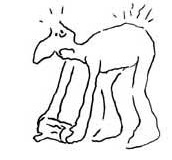
You know you shouldn't bend like this
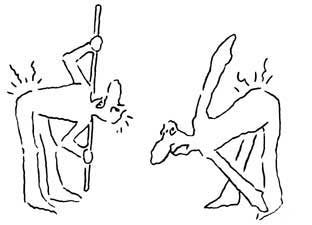
Bending like this isn't magically good for your back by calling it an exercise
Hamstring Stretches
A widespread myth is that tight hamstrings make back pain. That is not the case during standing and activity. Studies by several researcher have found no relation between hamstring flexibility and back pain. All about why, and what was mistaken for hamstring flexibility is on my Hamstrings page.
Based on the hamstring flexibility myth, fitness and rehab stretches are taught in ways that accrue back and disc injury. Leaning over at the waist and also for hip hinges at the hip, for toe touches does stretch your back and hamstrings, and may feel good, but places injurious leverage on the discs of the back and isn't even the best way to stretch the hamstrings. This is true even for yoga stretches where you bend over at the waist without supporting on your hands. You know never to bend over like that to pick something up. It doesn't magically become good for you just by calling it a stretch or a time-honored exercise. The weight of your upper body smashing down on your discs is the same as lifting a package like that. Although it often feels good on tight muscles, it's tough on your back in the long run. This does not mean that stretching or yoga are bad, but that some of the many poses, just like some of the many products in a health food store, are not as healthy as they could be, and there are other things to use instead. Many yoga instructors who understand this teach their classes with other poses instead of unsupported forward bending. It is injurious pressure on your discs to lean over from a stand no matter if you do it with a "flat back" or rounded "rolling up one vertebrae at a time." More on this in the Stretching book.
Try This Healthier Way To Stretch Your Hamstrings
This hamstring stretch retrains you to learn healthful spine posture, while it teaches how to get more stretch from the hamstring instead of teh back or hip. It is a functional stretch, meaning it practices hamstring length in the way you need it for real life - while walking, stepping, kicking, dancing, and other activities when you are standing and moving:
Stand upright, with both feet facing forward, not turned outwards.
Lift one leg up in front of you with the knee straight. You can hold your thigh with your hands if that helps. Notice if you are rounding your back or bending your standing leg. Notice if you are curving your neck forward or pushing your chin forward. Straighten your legs and spine without tensing or forcing.
- More about this, with photos, on the Hamstrings page.
To try a more involved way:
Stand no more than arms length from a wall. Stand straight. Both feet pointing straight ahead and parallel, not pointing outward, not even a little.
Lift one leg to press the whole foot and heel toward the wall, directly in front of you. It will feel too close - but this is how you get the stretch from your hamstring, not other areas of your body. You need to heel your hip back, not rounded under you.
Stand upright. Don't round your back, or let your hip curl under you. This is a functional hamstring stretch - learn to stand, lift legs, and balance without being so tight you are pulled into unhealthful rounding.
If your hip curls under, it may be because the front muscles of your hip are too tight. Use this retraining drill to stretch and straighten, not further round the back. This hamstring stretch is different and more functional than putting one foot up on a bench. See the Stretching article and other ways to stretch the Hamstrings in the Hamstrings article.
DeadliftingDeadlifting is done in so many different ways that often people argue about which is right without first defining which kind they are talking about.
Sometimes deadlifting is an exercise where you bend over forward at the waist or hip to lift a weight with legs straight. You already know you should not lean over from the waist or hips to lift things around the house or at work. Do you do this bad bending hundreds of times every day? Making the bed, lifting laundry, looking in the refrigerator, petting the dog, lifting children and packages, picking things up … all day every day. Then you go to the gym to do straight legged dead-lifting. Trainers claim it works the back and leg muscles. That is true but at the price of slowly (or quickly) harming your discs and other structures. You're adding cumulative sheer and force to your discs and missing a built-in opportunity to exercise your legs and burn calories if you would only lift properly. Another issue is position of the lower spine. For many years my research found neutral spine with upper body more upright is best for both exercise and preventing injury. My findings were not popular during the years of the fad of overarching the lower spine and pushing the backside far out in back. I also found that tightening and "locking" "bracing" and all the other terms for making muscles tight and rigid were not helpful, and trained bad movement and muscle habits. No real surprise - if anyone told you to tighten your legs and run, or tighten your neck and sing, you'd know it was counterproductive to functional movement.
Like other things, there are good and problematic ways to dead lift. A healthy deadlift is more like a good squat:
Body fairly upright
Knees bent and over feet, not swaying inward or sliding forward of the toes
Neutral spine, not arched.
Feet facing the same direction as knees,
Neutral neck, not hyperextended with chin up, but straight with the extension range coming from the upper spine
Good deadlifting becomes a functional exercise when you use it to pick up packages, children, and any other real -life things you need to crouch down to pick up and lift to any height.
Bent-over, straight legged deadlifting is another example of a popular exercise taught in ways that may "work" in one way but still have other undesirable effects. Like smoking to lose weight, it will "work" but is unhealthy for other reasons. Learn to think critically and understand that often several factors go into evaluating overall worth of an exercise. Instead, use good bending throughout the day - bending knees with upright body for hundreds of functional squats and lunges daily that train you for daily lifting and exercises your legs at the same time. Remember that you need to properly bend for hundreds of things all day every day - for real life. A few sets and reps in a gym won't do what daily good healthy movement for real can do. See the Fix Disc Pain article.
Neck Stretches
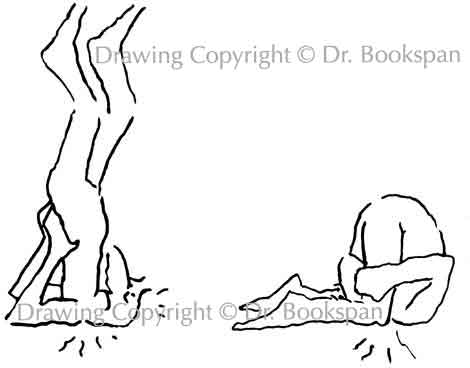
Forced neck stretches like pulling chin to chest, and shoulder stands including the yoga positions of The Plow and The Frog force discs outward, increasing risk of herniation over time. Forced head turning and rotation by practitioners of spinal manipulation is documented to sometimes result in stroke, even death from tearing neck blood vessels. More on pain free and healthy neck exercise and daily like is in the Neck Pain article.
Forced, weighted neck bending can - over time - push discs out of place, overstretch the back of your neck, and train a forward head posture. Most people already have a slouched forward neck posture.
You don't need to practice more forward head with an exercise you think is for your health.
Why Not Crunches?
Many people are taught that you need to work your abs to help your back. However simply strengthening a muscle will not automatically change how you stand or reduce back pain.
A survey in San Diego looked at which ab exercises produced the most ab muscle activation. From the results they listed these exercises as the best ab exercises. What they missed is that an exercise can work a muscle well but still promote unhealthful posture and not be good for the rest of you. Crunches don't train you how to use your abs the rest of the day when you are standing. Crunches make a person, who likely spends much of their day already hunched over a work area, practice that hunched posture which may be mechanically promoting the back and neck pain they think they are working their abs to prevent.
Many people are taught that in order to use their abs they must "tighten them." You can't breathe or move properly with tight muscles, and tight muscles are part of the problem in many pain syndromes. Using your abs does not mean "sucking them in," "tightening them," or "pressing your navel to your spine." It just means using them like any other muscle, without tightening. To do what?Abs connect ribs to hips. Abs work to bend your spine forward by drawing ribs and hips closer together. When you stand up and allow your lower spine to curve too much inward, that causes pain and problems and is not using the abs. Using abs means simply bending your spine forward enough to reduce an overly-arched posture, the same way you use your arm muscles to move your arm. But most people only exercise their abs by hunching forward for crunches and other forward bending. Then they stand and walk away, allowing their ribs to lift up, hips to drop down, and their back to arch - with no use of the abs at all to prevent this huge cause of back pain. This arching allows the weight of the upper body to pressure your low back.
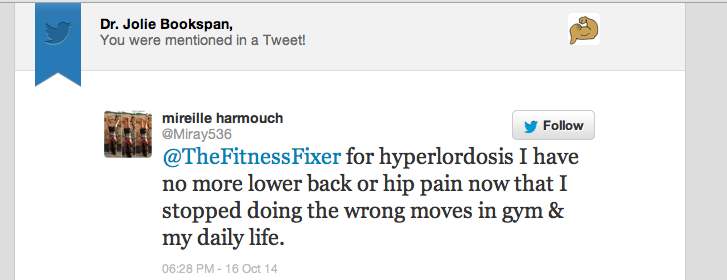
It is common to not notice all the exercises done in an arched posture. Hyperlordosis is the source of a specific mystery back pain. Even though abdominal muscles can prevent this problem, it is not stronger abs that do that, but you simply using the abs you have to reposition your spine out of back painful posture to pain free neutral spine. No ab exercises are needed - just repositioning training. Most ab training is done by bending forward - flexion - with no training for how to feel, recognize, or do neutral spine during your real life. More is in the Abs article.
Hyperlordosis (SwayBack)
Many people with back pain are told they have a "condition" called lordosis (often used interchangeably with the term hyper-lordosis, meaning swayback). They get the impression that too much inward curve tot he lower spine is something built-in, genetic, or unavoidable, or something that "just happens" to them. Worse, they are often told that a large inward curve is normal or desirable. These are all untrue. Hyper-lordosis is just a bad posture where you allow your lower back to sag inward too much. Technically the word "lordosis" originally meant the normal inward curve of the low back. It has commonly come to mean too much inward curve, allowing the back to sway. Increasing the inward arch allows the weight of your upper body to rest on your lower spine and soft structures, instead of your trunk (core) muscles. Too much inward sway can cause wear-and-tear on soft tissues and discs, and irritate the joints, called facets, where each vertebra attaches to the one above and below it. Hyperlordosis is a common cause of "mystery" lower back pain, but is just a bad posture habit. People are often told to exercise in this posture. You'll see it in an astonishing number fitness videos, poses, books, and classes, and in dozens of exercises from leg lifts to lifting weights, to using stretchy bands. The instructor may state the phrase "use neutral spine" but when you look at them, they are often arching their back with their hip tilted out in back at an angle that damages the spine. Hyperlordosis is a poor posture, not a sexy one, and a common source of back pain. More about all this and some fun and functional abdominal retraining is in the Abdominal Muscle article.
Allowing lower back over-arch (hyperlordosis, also called swayback) presses upper body weight onto your lower spine joints (facets) and soft tissue, causing much "mystery" lower back pain.
Retraining To Stop Hyperlordosis And Stand and Move in Healthful Position
One quick way to feel how to move your spine to decrease a large lumbar arch to a smaller neutral curve is to stand with your back against a wall and gently press your lower back toward the wall so that the space between your lower back and the wall decreases.
- Do not flatten completely, just use this to learn the motion of the pelvic tilt to DECREASE a large curve to a smaller one.
- Feel your hip tilt under you and the large arch in your lower back decrease.
- Hold the new straighter posture all the time.
- Do not tighten, clench muscles, or hold your breath to do it.
- Photos of swayback and fixing swayback, along with complete descriptions are on the Abs article.
Functional Abdominal Exercise Uses Neutral Spine
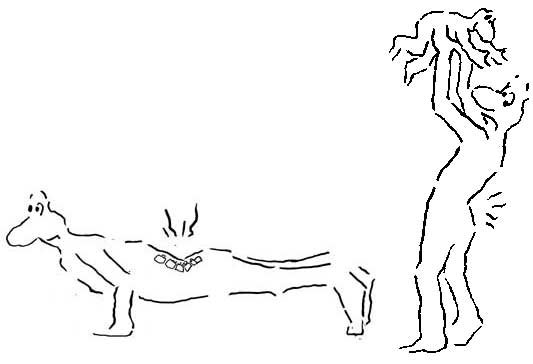
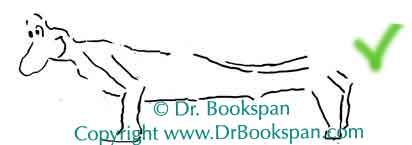
For a good exercise to work your abdominal and back muscles at the same time, while retraining good posture habits to hold your spine straight while standing, hold a pushup position. Keep your hips tucked, as if starting a crunch, to straighten your spine and get your body weight on your core muscles and off your lower back.
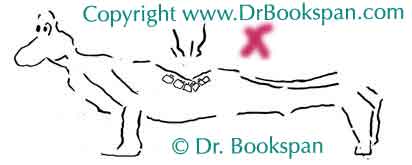
Do you allow your lower spine to sag?
Sagging (hyperlordosis) shifts body weight to the joints of the low spine (facets), and does not work core muscles.
When you tuck your hip to stop arching and pull to neutral spine, you will instantly feel abdominal muscles working. Pressure in your lower back will disappear. The weight of your body shifts to abdominal muscles and off your low back.
There are many good ab exercise like this that work your abdominal muscles while retraining how to hold your back without arching. Try variations on the pushup, with the tuck, above. Lift the back leg, without arching. Lift one arm in front. Lift the opposite leg and arm. Turn to the side to stand on one arm and leg. Keep torso posture straight without sagging in your middle, toward the ground. See the abs article for more.
What About Hands and Knees Leg Lifts? Another common back exercise where arching is a problem is leg lifts to the back. From a hands-and-knees position, the exercise is to lift one leg in back until level with your body, then lower. The way most people do this is to arch their back. The same problem happens with the standing back leg lift, very common in exercise classes. If they used their ab muscles to hold the spine flat and not arched, they would get a far better exercise and train how to use the body during movement. Here is how (Try these exercises in front of a mirror to better know your positioning
1. On hands and knees, first, let your back arch (sway downward like a saddle) and lift your leg slowly. You'll find it is easy to lift your leg. You may even feel the old familiar pressure in your low back.2. Now tuck your hips and upper body, as if starting a crunch, not curling forward but enough to straighten your back.
3. Lift your leg again without letting your back arch. You will feel you need to use far more low back and upper leg muscle to do this. You also need to use your abdominal muscles to keep your spine from sagging into an arch again. That is functional use of abdominal muscle - using them they way you need in real life to hold healthful posture, without any tightening, to create healthful movement. It is a more effective exercise that does not compressively load your lower spine joints and soft tissue in the process.
Using your abdominal muscles for real life and daily healthy movement is the key, not lying on the floor for a few minutes doing crunches. Strengthening is not what makes muscles move your spine from slouching into neutral spine. Using this new thinking about how abdominal muscles really work, you can use your muscles to hold your spine in healthy position.
The Ab Revolution new 4th edition shows how to fix painful spine position during all you do, in Part I. Part II gives exercises from the simplest to the most challenging.
Hyperlordosis is Controllable Right Then And There - No Exercises Needed
Use the above posture control technique technique all the time, during all your activities, and with everything you carry. It doesn't mean tightening your muscles, just moving your spine out of swayback to neutral spine. When you carry things, don't lean your upper body backward to "balance it" When wearing a backpack, don't arch back or or hunch forward. Use your muscles to keep healthful upright posture. It's more exercise and it's good for you.
Why A Pillow Under The Knees Doesn't Fix The Source of PainMany people are told that to alleviate back pain they must sleep with a pillow under their knees. The rationale is that lying on the back "makes" the back over-arch, creating hyperlordotic pain that pressures the back. A pillow under the knees reduces the arch by bending the knees. Does this solve the problem? The irony is that is exactly what perpetuates the problem. When the front of your hip is so tight that you can't stand or lie flat without your back being pulled into too much arch, you need to stretch your hip to stop the source of the problem, not keep your hip and knees bent, allowing it to remain tight and perpetuate the problem. Remember that you need to stand up without pain too - if you can't lie flat with a normal lower back curve, you can't stand up either. Are you supposed to walk around with your knees bent a lot? Bent knees isn't' the answer, removing the tightness in the hip is. Then you will be able to be comfortable without the pillow.
Don't remove the pillow under the knees without first removing the reason for needing it - the tight front (anterior) hip that prevents doing something as normal as lying down comfortably flat.
Is your upper body too stiff to be comfortable lying down without a pillow under your head too? You need to stretch your shoulders and chest so they don't hunch forward so much. That doesn't mean sleeping without a pillow, it is a test(a diagnostic) to see if you are too tight to have normal healthy life. No wonder so many people have so much pain. Simple stretches to restore healthful resting length to the front of the body are given in my books and summarized free on this web site. See the articles on neck pain and ab and core (back pain during standing)
Impact Activities Can Be Healthy
People may be told to give up all impact activities once they have back pain. Instead of learning how to move with shock absorption, they give up activities, but still walk around with poor shock absorption so that just walking is higher impact than if they ran, or even boxed, with good mechanics. Use your leg and truck muscles to walk softly and decelerate with each step, not just stomp and clomp, particularly when descending stairs or sloped ground, and when carrying things.
Done right, impact activity is healthy exercise and stimulates cell growth. Remember - use it in the way that helps, not harms.
Getting In and Out Of Chairs In Healthier Ways
Do you flop down in your chair, sitting down hard, jolting your spine? Instead, use your leg muscles to decelerate. Keep your upper body more upright. It's free healthful squatting exercise for all the many times a day you get into and out of your chair.
Can you get out of your chair without needing your arms? Can you sit and stand from your chair without leaning far forward? Don't tilt far forward. Use leg muscles to rise. Work on leg strength and balance.
Feet and Legs Facing in Different Directions - Twisting the Meniscus and Knee Cartilage
Angling the legs and feet outward is usually a bad foot and leg posture. If it doesn't feel normal to walk with feet pointing ahead straight, if may be simple tightness. It usually results from being too tight on one side and too weak on the other side to counter it. TIghtness may be in the bottom on the foot, toes that don't bend normally, Achilles tendon and calf, Ilio-tibial band, and hip. Walking with feet and legs working together to face ahead, not angled builds in the resting muscle length - giving a natural all day stretch needed for health and good walking mechanics. This does not mean to yank the feet in and make your knees hurt. It means to intelligently see where the tightness is coming from and making things healthy for the entire leg and body above it too.
Summary
Not all exercise is healthy, just like not all food. Use my work to understand the concepts so that you can tell what is healthy movement for yourself. Then apply it to your life - happy, healthy, active. Good exercise is crucial for health and recovery.
Moving and lifting in healthy ways does not mean never to bend forward, arch backward, or run around. You need good range of motion and frequent movement and activity for a healthy back. Check your posture and movement habits to see if you chronically hold a round-shouldered posture, or habitually let your back slump into an arch under your body weight and the weight of your back packs and the things you carry.
Don't let bad postural mechanics grind your joints to where pain will be harder to fix later. I am not saying not to exercise. Just the opposite. With the concepts of healthy body mechanics learned here, you will be able to do far more than before. The idea is to get you back to your life (and more) doing fun, exciting, and healthy activity.
Exercise as a lifestyle does not mean going to a gym a few times a week. It means how you move all day in real life. Get exercise as a lifestyle through all day healthy movement and your back can heal, and you can do more than before
This innovative information is now well used and established. Count how many times you bend and move and walk wrong every day - it will be many dozens of times. Then count the calories you'd burn by bending with your legs instead and how much you'd save your back. Done properly it is good for your knees too. You can strengthen during normal daily activities, become more active than before, and fix your own pain.
Fun Things That Help You Remember:- Watch other people’s posture, gait, and movement habits.
- Notice injurious postures doing "fitness and health" moves featured in fitness magazines
- Notice your own habits. .
- Learn more and have fun in-person at workshops Click here for class descriptions and schedules
Click Donate to send a thanks, or to support this free web site, secure through PayPal. Anything is appreciated
Thank you!If you want to argue that this article is wrong, put a nice figure in the donation box and it will send me your e-mail to learn from.
More Fun Things For You
Help this site without donating anything. Use the BOOKS page. Get anything you want, from song and movie downloads, health and medical fun things and elder care, home stuff, garden, computers, whatever. Amazon (or Kobo) will send me a small percentage, but never your name. Larger purchase send more to the site here, so get your next computer or house wares through these links :-) Thank you for helping this site by shopping for things you want anyway.
Patient Success Stories. Not testimonials, but tutorials so you can do it too. Read how others fixed their own pain, and see how to send yours.
Adventure Medicine - Higher, faster, stronger, smarter, funnier.
Academy of Functional Exercise Medicine - Fellow Advancement, Awards, Better Earth through Dr. Bookspan's Academy.
The Fitness Fixer™ - My column ran on Healthline from 2006 to 2010. After that, they took them all away in favor of their own articles that sell medicines and treatments, The BlogSpot archives still have some of them. Check for articles on Achilles pain, foot, shoes, orthotics, knees, back, nutrition, and more by alphabetical listing. Click here for the Index.
Bookspan Basics - Quick training drills for yourself andyour groups. Set up healthy movement training programs for schools and groups, eventually as part of my nationwide program. More Free ARTICLES on This Web Site
BACK PAINThe Ab Revolution™ - No More Crunches No More Back Pain. What abdominal muscles really do to help your back - it's not what you think - Change your whole understanding of abs
Lifting and Carrying - Secrets of fixing your back pain - some surprises - for everything you lift and carry, from groceries, to babies, to backpacks, to yourself
Sitting - Easy ways to stop back pain on planes, trains, from computers, and TV
Français! - La Révolution Abdominale™ Une Nouvelle Manière de Comprendre et d’Utiliser les Muscles Abdominaux
Español!-! Dolor de Espalda y Que Hacer?
NECK PAINFix Your Own Neck Pain, Neck and shoulder pain, rotator cuff, herniated neck discs, upper crossed syndrome, degenerating cervical discs, impingement.
KNEE PAINFix Your Own Knee Pain - Why you get knee pain and what to do.
BETTER EXERCISE
The Ab Revolution™ - Why crunches don't help back pain, and how to retrain your abs to help your back.
When Fitness Isn't Working - Avoid habits that work against your health.
Stretches That Help - Stretch the way you need for real life, and to feel better right now.
Functional Fitness - Exercise and Fitness as a (Real) LIfestyle - Building healthful body mechanics in to all you do.
Bookspan's Basics - Fun Functional Fitness drills for you, your groups, kids, schools, teams, and more
SMARTER HEALTHIER STRETCHING
Stretches That Help - Stretches That Harm - Stretch the way you need for real life, and to feel better right now.
Hamstrings - no relation to Back Pain. What are the real issues?
MENTAL & EMOTIONAL FITNESS
All the books together cost less than your pain killers. More about each of the books featured below, plus more books and resources are on my BOOKS page:
![ALT =[“Diving Physiology in Plain English - 8th edition Blue Cover Edition: by Dr. Jolie Bookspan”]](images/CoverDivingPhys%20eBookLR.jpg)
Don't
worry about people stealing your ideas.
|
That said, Be Healthy - Respect Copyright Information, drawings, and photos are © protected copyright. To cite this article or any parts, put author Dr. Bookspan, and link to this site DrBookspan.com at the top and bottom of your reprinting. A suggestion to get my books is also nice. No Derivative Works License means no changes to content, wording or links Drawings of Backman!™ copyright © by Dr. Jolie Bookspan from the books Health & FItness THIRD new edition, and Fix Your Own Pain. |
This
article is © copyright and here as a benefit to the world.
If fixes your pain, send it to a friend (the article, not the pain) with citation
to Dr. Bookspan and link
Pass on goodness. "Make health contagious."
Entire site is education only. Nothing is medical advice. See your doctor first and use your brain
HOME || Academy || Adventure Medicine || Bio || Books & Ebooks || Bookspan Basics || Classes || Diving, Aerospace, & Hyperbarics || Emotional & Mental Fitness || Fitness as a Lifestyle || Hamstrings and Back Pain || HUMOR - Fixa U Dept of Silly Syndromes || Karate || Kickboxing || Lower Body Revolution || Nutrition || Patient Success Stories || Rare Photos of Early Work || Stretching || Sitting || Thai Massage || The Fitness Fixer™ || Yoga
 A
Short History of My Work To Develop These Methods (skip
this to go straight to fix pain)
A
Short History of My Work To Develop These Methods (skip
this to go straight to fix pain) Their doctors started calling me (calling the lab actually, as I don't
have a phone) asking how I fixed them so well. They (and their physicians)
started taking classes with me. In the 1980s, class participants asked
me to write everything down for them. I was surprised. I thought they
should have taken notes. I typed information sheets for them. More doctors
came to me after taking my classes, saying they knew their standard
Patient Handouts were ineffective exercises. They asked me
to make handouts for their patients. I was surprised. Again. I thought
they could do that themselves. I typed Patient Handout sheets
for them. I kept collecting data like a good scientist, doing studies
to test and retest methods, and develop better ones. When the internet
came out, I sent handouts electronically, instead of photocopies. In
the 1990s I typed everything in several training manuals that became
books. One is Health & Fitness In Plain English - How To Be Happy,
Healthy and Fit for the Rest of your Life. After two different publishers,
the new THIRD edition of How To Be Happy, Healthy and Fit... eliminates
wrong things previous publishers added over my objections. Another book
is Fix Your Own Pain, with patient stories in every chapter
showing why patients get better, or don't, and why. Several more books
of my life's work tell how to make life pain free, stronger, and more
fun. Each book is different.
Their doctors started calling me (calling the lab actually, as I don't
have a phone) asking how I fixed them so well. They (and their physicians)
started taking classes with me. In the 1980s, class participants asked
me to write everything down for them. I was surprised. I thought they
should have taken notes. I typed information sheets for them. More doctors
came to me after taking my classes, saying they knew their standard
Patient Handouts were ineffective exercises. They asked me
to make handouts for their patients. I was surprised. Again. I thought
they could do that themselves. I typed Patient Handout sheets
for them. I kept collecting data like a good scientist, doing studies
to test and retest methods, and develop better ones. When the internet
came out, I sent handouts electronically, instead of photocopies. In
the 1990s I typed everything in several training manuals that became
books. One is Health & Fitness In Plain English - How To Be Happy,
Healthy and Fit for the Rest of your Life. After two different publishers,
the new THIRD edition of How To Be Happy, Healthy and Fit... eliminates
wrong things previous publishers added over my objections. Another book
is Fix Your Own Pain, with patient stories in every chapter
showing why patients get better, or don't, and why. Several more books
of my life's work tell how to make life pain free, stronger, and more
fun. Each book is different.